Kerala
Monuments
Thalassery Fort, stand testimony for the vantage position the
city enjoyed in the battles between Britain and Tippu Sulthan.
The first Malayalam daily, Rajyasamacharam, was published from
Illikkunu, a sleepy hamlet near Thalassery. Herman Gundert, a
German missionary was instrumental behind it. His another contribution
for Malayalam language was the first Malayalam Dictionary
The
centuries-old city is the cradle of Indian circus. Leading circus
artistes and circus companies have roots in this city.
St. Francis Church
Churches elsewhere in the country were modeled after this
Portuguese construction. A mute witness to the watershed events
in this coastal town, for past five centuries. Vasco De Gama,
the legendary navigator from Lisbon, died at Kochi during his
second voyage to Kerala. he was laid to rest in the St. Francis
Church on Christmas eve 1524. Years later, his mortal remains
were taken back to Portugal. The sepulcher is still preserved
in the church hall and is open for visitors.
Shri Chitra Art Gallery
His works include a number of portraits of Maharajahs and
members of royal family, distinguished British residents and prominent
figures.Antiques and curios once owned by Travancore royal lineage
are showed at Sree Chitra Art Gallery. Prized ones are Bengali
paintings, Rajasthani, Mughal miniatures, Tanjavore paintings
and selected works of Svetosku Roerich, a Russian artist.
Alwaye
Palace
On the banks of River Periyar stands imposing Alwaye( now
Aluva) palace ruminating over a past, long and eventful. One of
the finest palaces in the state with beautiful circular verandahs
overlooking the river.
Mattancherry Palace
Built by Portuguese and handed over to Cochin Raja in 1555
AD and the was renamed as Mattancheri Palace in 1663, when the
Dutch spruced up the palace. However, neither did Portuguese nor
Dutch stay in the palace.
Napier
Museum
Strips of blue and pink alternating with yellow and red,
scalloped arches of a banana yellow, elaborately carved balconies,
red and white lattice work and mock friezes make an engrossing
ensemble.
The ethereal beauty to the structure was added with the magical
brush up of Chisholm, a 19th century architect.
Padmanabhapuram Palace
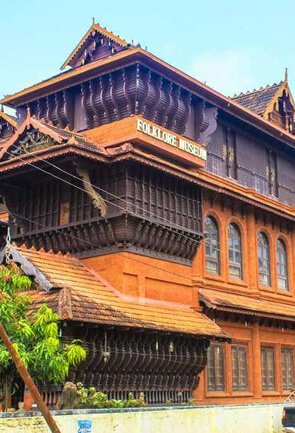
Padmanabhapuram palace is a 16 the century marvel on wood.
It flaunts the dexterity of Kerala's master carpenters Carved
wooden ceilings, slatted shuttered windows, intricate interlocking
beams, sculpted door panels and pagoda like tiled roofs stand
testimony to the deftness of architectures. Intricate carvings,
murals and exquisite wall paintings reflect the prolific talent
of the sculptors and painters who enjoyed the patronage of Travancore
kings
Tipu's Fort
The fort in the nerve center of Palakkad, built by Haider
Ali of Mysore, dates back to 1766 A.D. Today known after Haider
Ali's son Tipu Sultan. The fort still echoes the ballyhoo of those
troops which barged into it to fight pitched battles. The fort
was supposed to have built the fort to facilitate communication
between Coimbatore and Palakkad, two vantage points.. In 1784
after a 11-days siege, Lord Fullerton, the then British Colonel,
conquered the fort. Later Zamorin's troops wrested control but
the British occupied the fort in 1790.
Bekal Fort
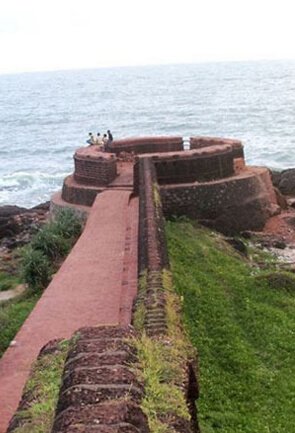
Bekal Fort, is 14 km off Kasargode, North Kerala. The pristine
Bakel beach along with the fort is being groomed into an international
tourist destination. The fort has historical as well as archeological
significance.