Blessed
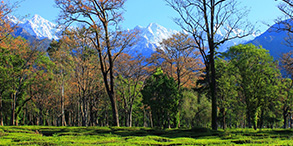
with some of the most spectacular and beautiful lands
capes
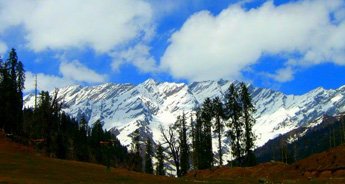
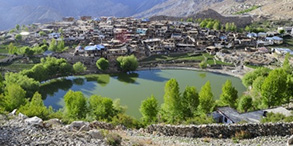
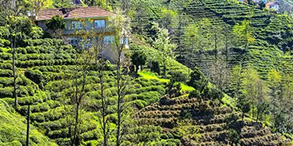
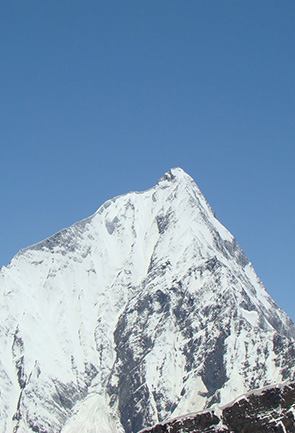
anywhere, it is a travellers paradise -lofty snow peaks, deep
gorges, lush green valleys, fast flowing rivers, enchanting mountain
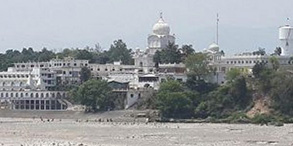
lakes, flower bedecked meadows, beautiful temples and monasteries
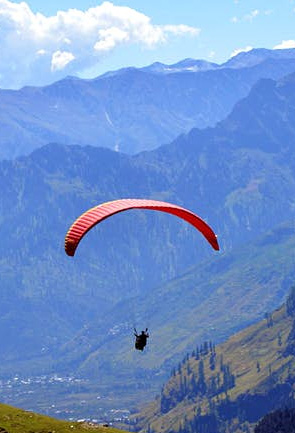
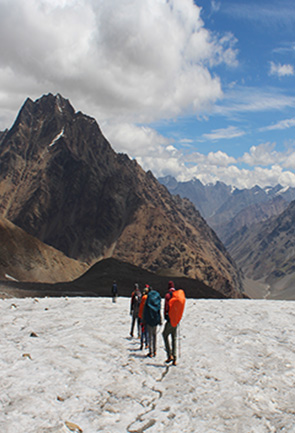
steeped in time. May it be for relaxing, sightseeing, trekking,
mountaineering, fishing, para-gliding, skiing, ice skating and
golf, Himachal has it all...Come Explore Himachal with Tour
my India...
The
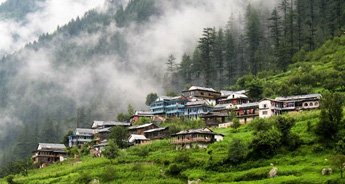
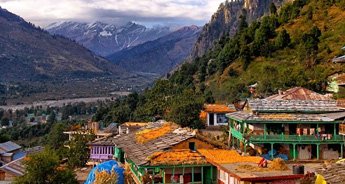
valley of gods, as the Kullu valley has come to be known, is perhaps
the most delightful region in the western Himalayas. The ancient
Hindus regarded it as the furthest limit of human habitation -
Kulantapitha, and its original name finds mention in the epics,
the Ramayana and the Mahabharata as well as Vishnu Purana.
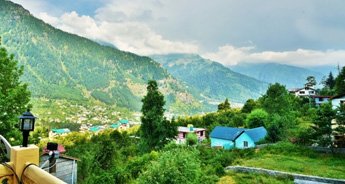
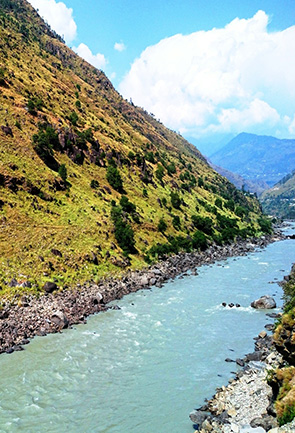
Like a slender delicate-hued fern glistening in the morning dew,
the valley spreads out its charm on either side of the upper reaches
of the river Beas. Running north to south, the main river valley
is only 80 km long and 2 km at its broadest, yet a fairly wide
area is open to the visitors to enjoy the spectacle of variegated
mountain scenery.
In
the spring Kullu is at its most colourful with pink blossoms and
white flowers while the higher slopes are aglow with gorgeous
rhododendrons. With utumn, clear blue skies return and fields
and forests alike show wonderful tints of crimson and ochre. By
December, there is no greenery except the majestic pines and cedars
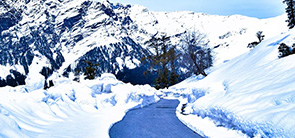
in the forests. In winter the hillsides are flanked in white.
Situated
on the banks of the Beas, Kullu, the headquarters of the district,
serves as a nerve centre of the valley and is the starting place
for a number of treks. The deodar-fringed grassy maidan, Dhalpur,
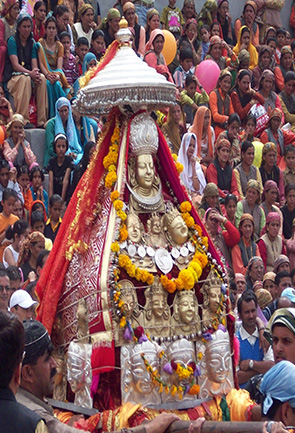
is a stage for many colourful fairs.
Places
to see in Manali
Kothi
12 km. A quiet but picturesque spot. The Rest House overlooks
the narrow valley and commands views of the mountains. Below Kothi,
for more than a kilometre the river Beas flows through a deep
gorge, almost a subterranean passage, 30 metres or more in depth,
and the cliffs which flank both sides of the canyon are a favourite
haunt for rock pigeons. The site of the bridge provides an interesting
historical episode in the early annals of Kullu.
Solang
Valley
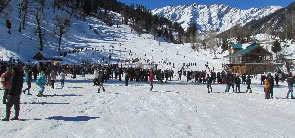
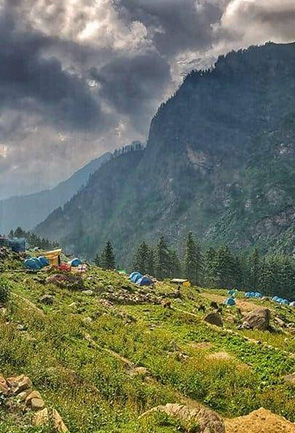
13 km. A splendid valley between Manali and Kothi which offers
views of the glaciers and snow-capped mountain peaks. The plateau
is frequently used for holding camps by the trekking parties.
Good skiing slopes of the Mountaineering Institute. Venue of annual
winter carnival from February 10-14. Bus service upto Palchan
village (10 km) and then by jeep or on foot.
Rahla
Falls
2 km from Kothi. Here the river Beas hurtles down from a height
of about 50 metres. Charming spot for picnics.
Manali
Sanctuary
A bridle path from the Manali log huts goes past the Dhoongri
Temple and wanders into the dense deodar, kail, horse chestnut,
walnut and maple forest which is a part of this sanctuary. Camping
overnight in tents at Lambadug or Galiani Thatch is possible.
Lush
green alpine pastures and glaciers lie beyond Galiani Thatch.
Musk deer, monal and brown bear are often spotted. For those who
venture still further into the glacier zone in summer, there are
herds of ibex.
Around
Manali
Rohtang
Pass
51 km. At an altitude of 4,112 metres on the highway to Keylong,
the pass affords a wide-spread panorama of mountain scenery. In
place of the pinnacled hills, sheltered valleys and cultivated
tracts, the eye meets a range of precipitous cliffs, huge glaciers
and piled Moraine, and deep ravines. Almost directly opposite
is the well defined Sonepani glacier, slightly to the left are
the twin peaks of the Geypang, jagged pyramids of rock, snow streaked
and snow crowned.
The
Beas river rises near the crest of Rohtang from a block of Mica-Schist.
The pass normally opens for traffic after mid-June and officially
closes in November. To its left, 200 metres higher, is the little
lake of Sarkund (Dashair) visited by a number of people, the general
belief being that a bath in these waters effects a cure of all
bodily ailments-real or imaginary. 10 km before Rohtang is the
barren-landscape of Marhi which hums with activity during summer
and autumn months because almost everyone stops here for refreshments.
Keylong
117 km. A fair sized village amidst green fields of barley and
buckwheat, Keylong is the headquarters of the Lahaul and Spiti
district, surrounded with brown hills and snowy heights. Karding
Monastery overlooks Keylong and is 3.5 km across the Chandra river
while Shashur Monastery is about 1 km. HPTDC Tourist Bungalow.
Triloknath
and Udeypur
These are two important places of pilgrimage in Pattan Valley.
At Triloknath is a six armed image in white marble of Avalokiteshvara,
Bodhisattava. Visitors will enjoy crossing the Chandra-Bhaga river
and the trek of 3 km to reach the destination. The temple of Marikula
at Udeypur is highly remarkable for its wood carvings. Udeypur
is 166 km from Manali.
Places to see in Kullu
Raghunathji Temple
1 km. In the 17th century, Raja Jagat Singh installed here an
idol of Lord Raghunathji, which he brought from Ayodhya. As a
mark of his penance he placed the idol on his throne and it became
the presidind deity of the valley.
Vaishno
Devi
4 km. A small cave enshrine an image of goddess Vaishno.Other
temples are dedicated to Lord Shiva, Rama and Krishna.
Jagannathi
Temple
3 km. A stiff climb leads one to the shrine from where one gets
a panoramic view of Kullu town.
Bijli
Mahadev Temple
11 km. The Bijli Mahadev temple one of the most striking temple
is set on a spur, and is famous for its 60 ft high staff which
periodically attracts lightning that shatters the Shivalinga.
Each time this happens, it is pieced together by the temple priest.
The
Great Himalayan National Park
Located in the beautiful district of Kullu, the 620 sq. km. area
has temperate forests - some of the virgin coniferous forests
of the state. Vast areas of alpine pasture and glaciers cap this
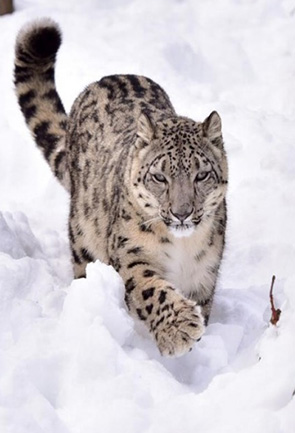
park. Among the animals found in this part of the western Himalayas
are musk deer, ghoral, thar, bharal, sewor, brown bear, leopard
and snow leopard. Bird life includes a variety of colourful pheasants
- monal, khalij, cheer and tragopan. A trek through the park to
Rekte-Sar, the origin of the Sainj River and camping amid alpine
pastures is a memorable experience.
Kanawar
Sanctuary
This sasnctuary located in the Parvati Valley of the Kullu District
is the habitat of the Himalayan thar. This big goat is often seen
on high mountainous precipices.
A splendid trek is possible along the Garahan Nalla from Kasol
through dense deodar and fir forests. The rest house at Kasol
is convernient and the Range Officer, Wildlife, Kasol, can offer
information and assistance.
Around
Kullu
Kaishdhar
16 km. A delightful spot (2,300 metres) for a quiet holiday where
one can commune with nature. Many walks in the neighbourhood.
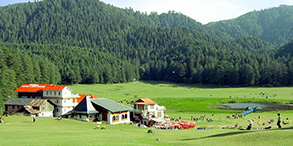
Forest Rest House provides accommodation.
Bajeshwar
Mahadev Temple (Bajaura)
15 km. The pyramidical temple (9th century AD) is embellished
with wonderful carvings in stone and sculptural decorations. The
three large image slabs on the exterior are all of a high order
of sculpture in the Indian classical (Shikara) style.
Kasol
42 km. Situated on the banks of Parvati river, Kasol in the Parvati
valley makes a good holiday destination. Charmingly located in
an open space which slopes down to a broad expanse of clear white
sand at the edge of the river. The place is known for trout fishing.
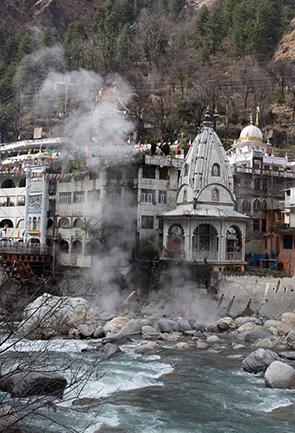
Manikaran
45 km. On the trekking route to Pulga and Pin Parvati pass, Manikaran
is famous for its hot springs. Thousands of people take a dip
in its hot waters. The water is so hot that dal (pulses), rice
etc. can be boiled in it. It is also a well known pilgrimage centre
and there is an ancient Hindu temple and a gurdwara here. According
to a legend, Manikaran is also associated with Lord Shiva and
his divine consort, Parvati, who lost and recovered her ear-ring
here.
Larji
34 km. South of Kullu at an elevation of 957 metres, this is a
small hamlet providing excellent trout fishing. A Rest House is
located in a stunning position, at an angle between the foaming
torrents of the rivers Sainj and Tirthan, before they join the
Beas a few hundred anglers.
Pulga
and Khirganga
16 km. A stiff march takes one to the restful solitude of the
Forest Rest House whose immediate environment affords a sylvan
and peaceful retreat for body and mind. The Tos nullah, which
branches off from the main Paravati valley is well worth exploration
by those who favour the wilder aspects of natural scenery and
are prepared to camp out. 10 km from Pulga lies Khirganga which
is well-known for its hot springs.
Banjar
58 km. an excellent spot (1,534 metres) for trout fishing in Tirthan
river. the famous temple of Shringa Rishi is located here in whose
honour a fair is held every year in May.
Accommodation is available at a PWD Rest House.
Shoja
13 km from the Banjar PWD Rest House (2,650 metres) on the Kullu
side of the Jalori pass, it is located in a setting of marvellous
scenic surroundings.
Raison
16 km. On the way to Manali, it is an ideal site at an elevation
1,433 metres for spending a quiet holiday in solitary splendour
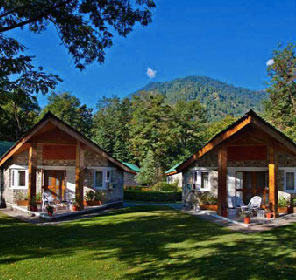
and for holding youth camps and rallies. On the gurgling banks
of the Beas there are 14 wooden huts of HPTDC.
Katrain
20 km. The central and the widest part of the valley on the way
to Manali and at a height of 1,463 metres. Apple orchards, a Fruit
Research Station and a trout hatchery lend prominence to the place.
Naggar
28 km. On the left bank of the Beas and about three hundred metres
above the river, Naggar is delightfully situated on a wooded slope
and commands an extensive view, especially of the north west of
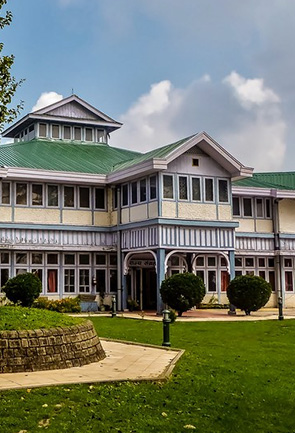
the valley. It is an excellent place for a longer stay. Naggar
was the capital of the Kullu Rajas for about 1,400 years. There
are a large number of famous temples in and around Naggar. Artist
Nicholas Roerich's art gallery is also worth a visit. Cars and
jeeps can easily go up to the Naggar Castle.
Malana
28 km. up to Naggar by bus and then 20 km. on foot. A little ahead
off the beautiful Chandrakhani pass lies the tiny village of Malana,
famous for the temple of Jamlu and its distinct social and cultural
life. Reputed to be the oldest democracy in the world in existence
where all the inhabitants of the village take part in managing
its affairs. An exciting place for trekking.
Chail-kufri
Chamba
Dalhousie & Kajjiar
Dharamshala
Kalpa & Sangala
Kasauli
Kinnau & Kangra
Kullu-Manali
Lahul Spiti
Nahan & Solan
Naldera
Parwanoo & Masorba
Shimla