Varanasi
(
Ghats )
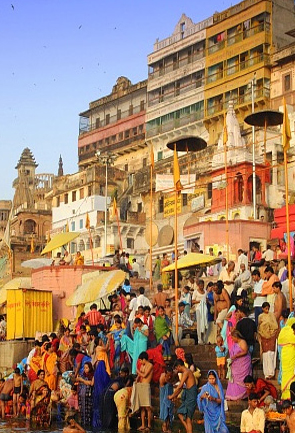
Dasaswamedh
Ghat : The name of Dasaswamedh Ghat indicates that Brahma
sacrificed (medh) 10 (das) horses (aswa) here. Conveniently central,
it's one of the most important and busiest ghats and therefore
is a good place to linger and soak up the atmosphere. Note its
statues and the shrine of Sitala, goddess of smallpox.
Tulsi
Ghat : Tulsi ghat is named after the famous 16th century poet
Tulsidas, who spent many years here composing the Ramcharitmanas.
His manuscript, it is said, floated instead of sinking in the
Ganga. The first performance of Ramlila was held here. A temple
of Ram stands on the ghat. The house in which the poet died preserves
his samadhi, his wooden clogs, pillow and the idol of Hanuman
which he worshipped. There is also a piece of wood from the boat
used by him to cross the Ganga.
Dandi
Ghat : The Dandi Ghat is the ghat of ascetics known as Dandi
Panths. The spartan Hanuman ghat is used by wrestlers and body
builders for whom Bajrangbali (Hanuman) is the patron God. Saint
Vallabhacharya lived here.
Kedar Ghat : Kedar Ghat built by the Maharaja of Vijayanagar
in the South is named after Shiva, who dwells in the middle of
the spacious temple.This ghat is shrine popular with Bengalis
and south Indians. A little below is the Gauri (Parvati) kund
whose waters have healing properties.
Mansarowar
Ghat : Mansarowar Ghat was built by Raja Man Singh of Amber
and named after the Tibetan lake at the foot of Mt. Kailash, Shiva's
Himalayan home.
Manikarnika
Ghat : Manikarnika Ghat,one of the oldest and most sacred
in Varanasi. Manikarnika is main burning ghat and one of most
auspicious places that a Hindu can be cremated. Bodies are handled
by outcasts known as doms, and they are carried through alleyways
of old city to the holy Ganges on a bamboo stretcher swathed in
cloth. The corpse is doused in Ganga prior to cremation. You will
see huge piles of firewood stack along the top of the ghat, each
log carefully weighted on giant scales so that the price of cremation
can be calculated. There are no problems watching cremations,
since at Manikarnika death is simply business as usual, but don't
take photos and keep your camera well hidden.
Dattatreya
Ghat : Dattatreya Ghat bears the footprint of Brahmin saint
of that name in a small temple nearby.
Panchganga
Ghat : Panchganga Ghat as its name indicates, is where five
rivers are supposed to meet. Dominating the ghat is Aurangazeb's
smaller mosque, also known as the Alamgir Mosque, which he built
on the site of large vishnu temple erected by the Maratha chieftain
Beni Madhav Rao Scindia.
Man
Mandir Ghat : This ghat was built in 1600 but was poorly restored
in the 19th century. The northern corner of the ghat has a fine
stone balcony and Raja Jai Singh of Jaipur erected one of his
unusual observations on this ghat in 1710.
Harishchandra
Ghat : The Harishchandra Smashan Ghat is a secondary burning
ghat. It is one of the oldest ghats in city.
Assi Ghat : The Assi Ghat is one of the five special ghats
which pilgrims are supposed to bathe at in sequence during the
ritual route called Panchatirthi Yatra.
Trilochan
Ghat : The Trilochan Ghat has two turrets merging from the
river, and was water between them is especially holy.
Bachraj
Ghat : The Bachraj Ghat is a Jain and there are three riverbank
Jain Temples. Many of ghats are owned by Maharajas or other princely
rulers, such as the very fine Shivala Ghat owned by the maharaja
of Varanasi.