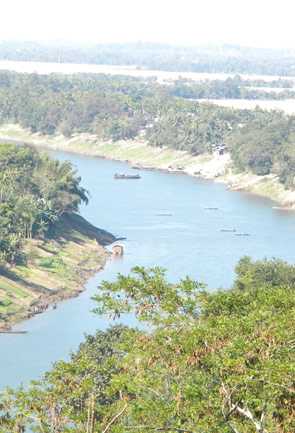
Manipur
Attraction
(
Keibul Lamjao National Park )
It
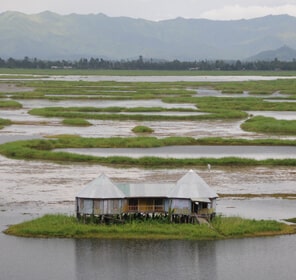
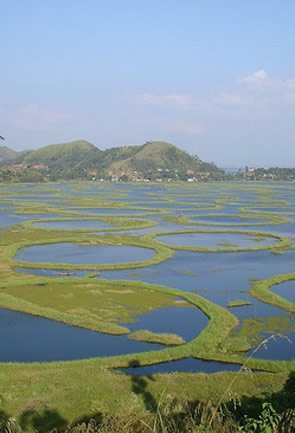
is the only floating National park in the whole world and is 53
kms. from Imphal. This is the last natural habitat of the marsh-dwelling
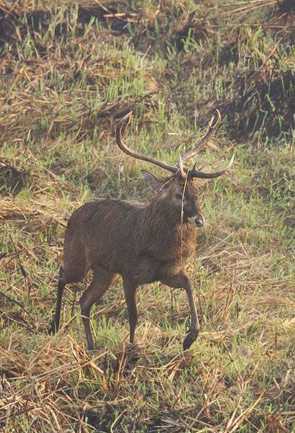
brow-antlered deer of Manipur called "Sangai". Many waterfowl
and migratory birds visit the Lake during November and March. The
National Park is on an island inside the lake. The lake has colourful
water plants and provides facilities for boating and fishing. Elds
deer, Thamin deer, Brow-antlered deer, Sangai Dancing deer
A whole lot of names for a single species, but thats how it
is for this unusual deer, a graceful animal found only in Manipur-India.
A highly endangered species, the brow-antlered deer is found exclusively
in a small area, which stretches across the extreme northeastern
corner of India; Myanmar and part of Thailand. In India, this beautiful
creature is found at the Keibul Lamjao National Park. Keibul Lamjaos
other claim to fame is the fact that this is one of the very few
`floating protected areas in the world. Keibul Lamjao lies
on an island on the fringes of the Loktak Lake. Gazetted a sanctuary
in 1969, Keibul Lamjao officially became a national park in 1977and
today stretches over an area of about 40 sq km, surrounded by marshes,
hillocks, and the lake itself. A number of streams too crisscross
this which, combined with extensive marshes, make the park a typical
wetland. The most prominent spotted `sangai' deer had been reported
extinct in 1951, but after being re-discovered, has finally become
Keibul Lamjao's prime attraction. Other animals in the park include
otter, civet, wild boar and hog deer, besides a number of small
reed-dwelling birds.
History
The entire Loktak Lake was protected and declared a sanctuary
in October 1953, mainly to save the sangai deer, which was threatened
by extinction. But luckily, following the re-discovery of the deer,
in July 1954, hunting was once again permitted except for a small
portion at the southern tip. This area was officially notified as
a sanctuary in 1966 and a decade later, on March 28, 1977, the Keibul
Lamjao National Park was created. Obviously, by then no hunting
was allowed at all.
Terrain
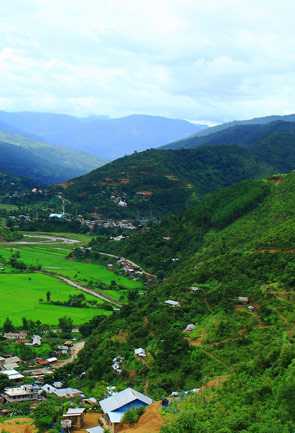
The Imphal Valley in Manipur is a highland plateau. The open
plateau is pockmarked by innumerable small hillocks. Six major streams
and their numerous tributaries that flow down from the hills into
the central plain water the area.
Flora
Keibul Lamjao consists of the unique 'phumdi' or floating marshes.
Approximately about half a century ago, the predominant plants used
to be tou, singut, and khoimom. But the composition of the vegetation
has undergone rapid changes and the plant cover, at present, is
estimated to comprise of equal proportions of hoop Leersia hexandra
and sing kambong Zizania latifolia, a protein-rich plant, often
used as food. Khoimom Saccharum munja and singut Narenga porphyrochroms
are found in even lower proportions.
Fauna
Some rare animals may be encountered in and around this wilderness.
The star attraction, of course, is the brow-antlered deer Cervus
eldi eldi, called sangai. It is fondly called Manipurs dancing
deer because of its delicate gait as it negotiates its way along
the floating wetlands. The other two subspecies are found in Mynmar
and China. Other species of deer seen here include the hog deer,
sambar and muntjac. The hog deer has also vanished from the rest
of the Manipur valley and isolated populations occur only in the
park. Sambar and muntjac are found in the hills, surrounding the
entire area. Assamese and stump-tailed macaques and the Hoolock
gibbon are restricted mainly to the western hills. The Rhesus monkey
is found ubiquitously around the park. The large Indian civet Viverra
zibetha and small Indian civet Viverricula indica, common otter
Lutra lutra and wild boar Sus scrofa are some of the large mammals
noted in the area. Extremely rare lesser wild cats like the marbled
cat and Temmincks golden cat may be sighted occasionally and
the Himalayan black bear and the Malayan bear are also be seen foraging
for food.
Birdwatchers
Delight
A variety of rare birds occur in Keibul Lamjao and the Loktak
Lake. The avifauna consists primarily of the smaller reed-dwelling
species. Waterfowl are becoming more rare because of the lack of
open water surfaces. The Hooded Crane may be seen in the Manipur
valley. The Black Eagle and the Shaheen Falcon are some of the raptors
seen here. The Eastern Shite Stork, Bamboo Partridge and Green Peafowl
are also found here. Species of hornbills found here include the
Brownbacked Hornbill, Rufusnecked Hornbill, Wreathed Hornbill, the
Pied Hornbill and the Great Pied Hornbill.
Information
for Foreigners
Entry Requirements All foreigners visiting Manipur are required
to obtain special Restricted Area Permits (RAPs), which are valid
for entry to Keibul Lamjao National Park. Permits valid for a period
of ten days are issued to groups of four or more people travelling
together on a tour arranged by recognised travel agents.
Entry
for Indians
Indians visiting Manipur are required to obtain an Inner Line
Permit. Like the RAPs, these are also valid for visits to Keibul
Lamjao.
How
to Reach
The closest major town is Manipur's capital Imphal. The best
way to go around Keibul Lamjao is by boat- and that too in the early
morning or in the evening, when the lake's at its loveliest. The
sangai, living in small herds, lie low through most of the day and
come out to feed either around dawn or at dusk, which makes a circuit
even more satisfying for wildlife-watchers. Within the park are
observation towers offering a good view of sangai habitat. The park
has several distinguishing features. Apart from the vegetation and
terrain, an important highlight of the park is the Loktak lake -
the largest freshwater lake in India; a large portion of which falls
within the park.
|