Cities
In Kerala
( Cochin )
Area
:
8,700 sq km
Population : 1,600,000
Languages : Malayalam and English
Best time to visit : December to May
STD code : 0484
Introduction
In Cochin or Kochi, dawn is not often a thing of breathtaking
beauty, but just a careless smear of tinted light where sea and
sky unite. Daybreak is full of indeterminate promise. A slow lividness
at the mist-obscured harbor mouth meets the swelling untamed surge
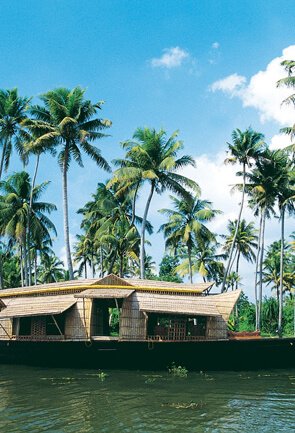
of the ocean. Cargo-laden barges and vallams or country boats
move, ponderously slow, over the sprawling vastness of the Vembanad
Kayal, Keralas largest lake that spreads full bosomed and
silver gray in the sultry sun.
Location
Popularly referred to as the Queen of the Arabian Sea, Cochin
is located on the west cost of India in the beautiful state of
Kerala. The city can be regarded as the commercial and industrial
capital of Kerala. The city extends from latitude 9°58' in
the North to longitude 76°17' in the East.
Climate
Being situated very close to the sea, Kochi has a moderate climate,
with heavy rains during JuneAugust due to the southwest
monsoon. Winter starts from December and continues till February.
In summer, the temperature rises to a maximum of 35°C and
25°C in the winters. Annual average rainfall is 310 cm.
History
Though Cochin had been an important roadstead in days gone by,
it became a natural harbor only when nature decreed it so. Muziris
(present-day Kodungalloor on the mouth of the Periyar River),
40 km north of Cochin, was the center of trade with ancient Rome
in the products like pepper and pearls, fine silks, cotton, muslin,
honey, oil, betel, tortoise shell, cinnamon leaf, black pepper,
ginger grass, and indigo.
The
formation of Cochin harbor has a violent story of which nature
herself was the main character. The harbor was formed in a.d.
1341, when a great flood in the Periyar River led to an outlet
in the sea. The floods had meanwhile silted up the mouth of the
Muziris harbor and this rich ancient port was banished to the
footnotes of history. Meanwhile, the merchants of Muziris shifted
to Cochin.
For
centuries, Cochin was the battleground of European powers for
the mastery of the lucrative trade of the Indian west coast. The
fortunes of political powers in Cochin were dictated by pepper.
The Portuguese were the first to come in. Two years later, the
adventurous mariner, the legendary Vasco da Gama himself landed
in Cochin. The Portuguese erected a fort for the protection of
their factory. Fort Manuel, or Manuel Kotta, named after the King
of Portugal, was the first fortress constructed by the Europeans
in India.
To
the Portuguese must go the credit for the extensive scientific
cultivation of coconut, ginger, and pepper, backbone of Keralas
economy today. Tobacco, cashew nut, and fruit cultivation were
also introduced. The pineapple, for instance, is still called
prithichakka in Malayalam, meaning Portuguese jackfruit. They
were also responsible for todays burgeoning trade in coir.
The
Dutch, full of energy and zeal, were next to enter the scene and
succeeded in throwing out the Portuguese very soon. Helped by
a laissez-faire policy and a self-stipulated dictum of at
least a 100% profit, Cochin saw a great resurgence of trade.
But
the Dutch never endured too, and it was the British who came in
next to play out their role. A great milestone was the direct
export of pepper to England in 1636 and once again, power flowed
from pepper.
For
a hundred years and more, from 1795, Cochin received a gracious
patronage of the British. They tried their best to develop the
harbor at Cochin, the gateway of South India, but for long dismissed
as a dream beyond the realm of hope for a rock-like barrier of
sand blacked the approach to the port from the sea. No dredging
proposition since the days of the Suez Canal project has aroused
so much technical interest as the opening up of the Cochin Harbor.
It
fell to the lot of an Admiralty Engineer Sir Robert Bristow to
envision this marvel of engineering. It was not an
easy task for Bristow to construct a port in these serendipitous
surroundings.
Cochin
was declared a major port in 1936. With its opening, there was
a complete reorientation of shipping and commercial activities
on the Malabar Coast. With its year-round shipping facilities,
it is the busiest port south of Bombay, lying as it does on the
direct route to Australia and the Far East from Europe and serving
the vast southern hinterland of industrial areas and plantations.
It is a passenger port for the United Kingdom and America in South
India. Moreover, it is one of the few ports of the world with
all the three main forms of transportland, sea, and air,
centered in the same place.