| Indian
States
Introduction to Pondicherry
The
name Pondicherry has been derived from the Tamil word Puducheri
signifying 'the new settlement'. It was a French settlement that
comprised Pondy, Yanam, Karaikal, and Mahe. Amazing is the fact
that different districts of Pondicherry fall under different
states. The capital Pondicherry is situated in the state
of Tamil Nadu at a distance of around 200 km from Chennai. While
Karaikal is also a part of Tamil Nadu, Mahe is located in Kerala,
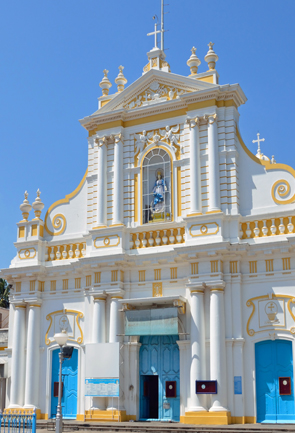
and Yanam is in Andhra Pradesh. There is a strong influence of French
culture on Pondicherry town, especially on it's architecture,
a result of the centuries-old relations this place maintained with
France. Today, Pondicherry is more famous because of its
relation with Sri Aurobindo. Sri Aurobindo selected this peaceful
and harmonious place to make his abode in the second decade of this
century and remained there till his death. A political revolutionary
before coming to Pondicherry, he became one of the most famous
sages of modern times produced by India.
SRI AUROBINDO ASHRAM
Founded in 1926, the Sri Aurobindo Ashram has grown, under the Mother's
guidance, from a small group of two dozen disciples into a large
diversified community with almost 1200 members. Counting the 400
students of the Centre of Education and the hundreds of devotees
who live nearby, the larger ashram community consists of more than
2000 people.
Situated in a busy
city of over 700,000 people, the Ashram is not a quiet place of
retreat but a vibrant centre of life in a modern urban setting.
The dynamic character of the community reflects the life-affirming
aim of Sri Aurobindo's Yoga. Work as an offering to the Divine is
an essential aspect of the Yoga, and all Ashramites do a certain
amount of productive work each day in one or another of the Ashram's
departments.
In the sadhana or
spiritual discipline at the Ashram, there are no obligatory practices,
no rituals, no compulsory meditations or systematic instructions
in Yoga. Sadhaks are left free to determine the course and pace
of their sadhana in accordance with their own natures. But the general
principle of the sadhana is the same for all: there must be a surrender
to the Divine and an opening to the Divine Force so that it may
work to transform one's being.
The Ashram is located
in the eastern part of Pondicherry. Ashramites live and work
in a large number of buildings spread throughout the area. The focus
of community life is the Ashram main building, usually called simply
"the Ashram", which consists of an interconnected block
of houses, including those in which Sri Aurobindo and the Mother
lived for most of their lives. At its centre, in a tree-shaded courtyard,
lies the Samadhi, a white-marble shrine where their bodies are laid
to rest.
The Ashram provides
its members with all they need for a decent and healthy life. Various
departments have been organised to look after the basic requirements
of food, clothing and shelter, as well as medical care. The Ashram
has farms and gardens, a printing press and a number of small-scale
industries. There are also libraries for study and facilities for
a variety of cultural pursuits.
The
History of Pondicherry
Not much is known about Pondicherry before the foreign settlement
started. There are evidences of the Pallava, Chola and the Vijayanagar
empires around the city. What is interesting are the relics of Arekmedu,
the famous archaeological city with a port through which major trade
was conducted with the Roman Empire. It is through this port that
India used to export silk, spices, even birds, lions, elephants
to the Roman Empire in exchange for gold."
In the 16th century,
the Portuguese first arrived here and then the following century
the Danes made an appearance. In 1673, the French arrived. Till
then, Pondicherry was a weaving and fishing village. The French
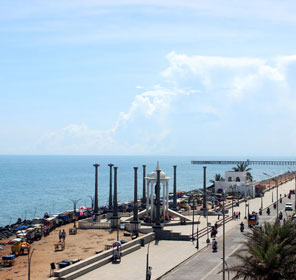
quarters started along the sea and extended to the south, all along
the sea. The city slowly emerged with the fort at its center. The
town planners tried to implement this grid system methodically.
It required the reconstruction of many houses, mostly those of the
Tamilians. It also required the strict implementation of regulations.
In all, it took the French almost a century to implement the plan-that
of the present concentric pattern with the fort at the center and
boulevards surrounding it. It has, however, expanded beyond the
boulevard in recent years.
Today, some adjacent
areas, which were previously villages, have been included within
the city limits. Around the 1760's, the British destroyed the city
including the fort. When the French reoccupied it, most of the buildings
were reconstructed but not the fort.
In the latter part
of the 18th and early 19th century, Pondicherry again fell
into British hands and all construction activity came to a standstill.
Most of the present day buildings came up in the 19th century, which
also marked the advent of water supply in the city and the railway
link with British India. By the 20th century, the city had expanded
to include many neighboring villages, although few changes were
made in the inner city.
This French colony
became a part of the Indian Union in the early 1950's, with the
French voluntarily relinquishing control.
Today, the Union
Territory of Pondicherry includes the other three French enclaves
of Karaikal (in Tamil Nadu), Mahe (in Kerala) and Yanam (in Andhra
Pradesh).
Facts
& Figures of Pondicherry
Area : 492
Sq Km
Population : 973,829 (2001)
Religion : Hinduism , Christianity and Islam
Annual Rainfall : 993.4 Degree Centigerade
Temprature : Max(31.90 Degree Centigerade) Min ( 24.50 Degree
Centigerade)
Capital: Pondicherry
Languages : Tamil , Malayalam and Telgu.
Literacy Rate : 81.49 %
Per Capita Income : 11,677 (1997-98)
Best Time to Visit : March to October
How to Reach Pondicherry
By Air: Nearest airport from Pondicherry is Chennai
162 km. One can take flights for most of the important Indian cities
many places abroad Chennai International Airport.
By Rail: Pondicherry is connected through a meter gauge railway
line with Villupuram. There is only one railway station between
Pondicherry and Villupuram i.e. Villianur. Most people generally
do not prefer trains and take buses instead.
By Road: Pondicherry is well connected to most of the major
towns of southern India by road. Buses ply between Pondicherry and
Chennai regularly as well as for other important cities of this
region.
|