|
Location:
Pondicherry
Famous Ones: Park Monument, Arikamedu, Ananda Ranga
Pillai Mansion, The Statue Of Dupliex, Palace Du Governement &
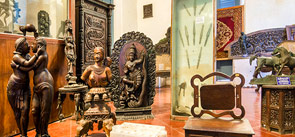
The Pondicherry Museum
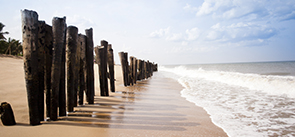
Other Attractions: Beach Road, The Fishing Village
& South Boulevard
VESTIGES
& MONUMENTS
A wondrous history of this place is told by obliging Pondicherrians.
As well as the striking grid like street planning buildings and
monuments. About the arrival of the European maritime powers of
the 16th century the Portuguese the Dutch, the Danes, the English
and importantly, the French, setting foot first in 1670.
About
the transformation of a tiny fishing village into a grand port city
by the 18th century, brave generals, friendly maharajas and even,
philanthropic courtesans. And about an undisturbed French rule for
138 years till 1954.
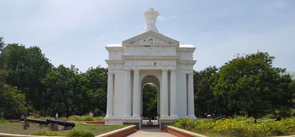
Park Monument (Aayi Mandapam)
The most beautiful public space in town is the green and shaded
Government Park, in the heart of Pondicherry. Standing smack in
its centre is Aayi Mandapam. Built in Greco-Roman architecture,
unsinfully white, during the reign of Napoleon III -Emperor of France.
It bears the name of Aayi - a 16th century courtesan. Who razed
down her home and replaced it with a reservoir. To appease a passing
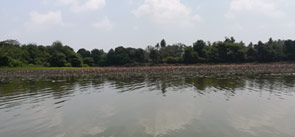
king, angry at having mistaken her candle-lit residence for a holy
place. It was from this lake that Napoleon's men quenched their
thirst, some 300 years later. Napoleon, charmed by the story, ordered
a monument to Aayi.
Ananda Ranga Pillai Mansion
Ananda Ranga Pillai was the celebrated Dubash of Dupleix, the governor
of Pondicherry, while it flourished under French glory. Pillai's
compilation of diaries serves as a storehouse of information on
18th century French India.
His mansion completed sometime in 1738 is one of the oldest surviving
buildings on the west side - then known as "natives' quarters."
Its architecture represents a curious mix of French and Indian styles.
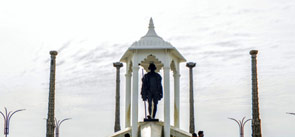
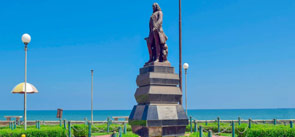
The Statue Of Dupleix
This is Pondicherry's tribute to Francois Dupeix, whose able governorship
came to an end in 1754. However, French recognition came about a
century later, when, in 1870, they paid homage by commissioning
two statues - one in France and the other in Pondicherry.
The 2.88m tall structure was erected over six carved ornamental
granite pillars at the Place Du Republique. It now stands re-stationed
overlooking a children's park at the southern end of the promenade,
now named Goubert Avenue.
Place Du Gouvernement
The Place Du Gouvernement is a brilliant example of town planning
in Pondicherry. Comprising the 18th century "Palais Du Government"
- now the 'Raj Nivas' (not open to the public) - and the old tribunals
- now housing the Legislative Assembly - along with a neat three-sided
line-up of other handsome buildings.
At the centre, surrounded by a well-tended garden, stands the water
monument, sculpted to commemorate the introduction of good drinking
water for the population. Latin and Tamil inscriptions bear out
the story. Some exquisitely carved monolithic pillars, brought to
Pondicherry from the Gingee Fort after its capture in 1751, adorn
the place.
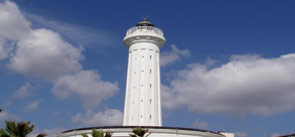
19th Century Light House
The early sea-farers to Pondicherry were guided by a beacon kept
burning on the red hills (Gorimedu), about 5-km west of the town.
The now-abandoned light house standing on the edge of the sea near
the Place Du Gouvernment was lighted for the first time on 1st July
1836. The light was placed upon a masonry tower, 29m above sea level
and was visible upto a distance of 29-km into the sea. In 1931,
a revolving lantern replaced the fixed light. It fell into disuse
with the commissioning of the new light house in 1979.
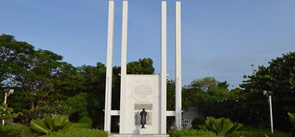
French War Memorial
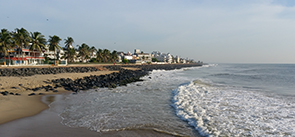
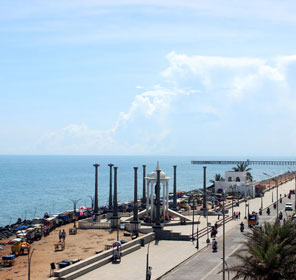
No visit to Pondicherry is complete without a free wheeling stroll
down the peaceful Promenade Goubert Avenue (locally known as Beach
Road), where one will find this elegant tribute to the uniform.
It gets prettily illuminated during a solemn ceremony every 14th
July, Bastille Day.
The Statue Of Joan Of Arc
A lasting, triumphant image of the heroic French damsel Jeanned'Arc,
is frozen in marble, within the garden laid out in front of L'Eglise
de Notre Dame des Anges.
BUILDINGS
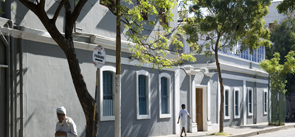
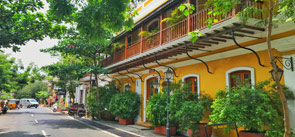
In The French Quarters:
Hotel Lagrenee De Meziere, 1774: Once a private house, this
place has now become a workshop of the religious order of Saint
Joseph De Cluny. One can put his head in the gate and have a look
at magnificent early colonial architecture and equally beautifully
embroidery.
Lacee Francais, 1826 : Lacee Francais, still educates hundreds
of young Pondicheriens in French. One has to take permission from
the office walking around the old courtyard to see photographs of
colonial Pondy in a fine old building.
Le Grand Hotel D' Europe: Opened in 1891, this hotel has
got a classic look and is closed to the public.
L'ecole Francaise D'extreme Orient: Meaning, the French institute
of the Far East whose two handsome buildings are almost diagonal
to each other at an intersection, one specialising in Indology,
the other in History and Archaeology.
In The Ashram Quarter:
The French Consulate General: This place is open to French
nationals. The whole facade and shape of the building have changed
over the years, but it still retains some elements from the 18th
century.
L'institut Francais: As the gate is generally open, one may
walk into the courtyard and have a quiet look around. They have
a very old Ganesha statue. If one has a professional interest in
Indian civilisation, history and society, in ecology, or in environment
and development in South and Southeast Asia, one may pick up the
institute's information materials describing current activities.
Le Foyer Du Soldat: This place is the legion hall for retired
soldiers from Pondicherry who served in French wars in Europe and
the colonies. The building looks perky enough with its proud Tricouleur
or tricolour (red, white and blue flag) but the veterans must be
getting on! |