|
Indian States
General
Information
Introduction:-
Chandigarh,
derives its name from a temple Chandi Mandir in the vicinity of
the
site selected for the city (deity Chandi, goddess of power), and
a fort or garh" beyond the temple, called Chandigarh..
Chandigarh was conceived as the
capital of Punjab, in lieu of the lost capital at Lahore. But Punjab
was divided a second time in 1966, and Chandigarh is today the capital
of the States of both Punjab and Haryana. However, the city does
not belong to either. Chandigarh is a Union Territory, administered
by the Government of India.
Chandigarh
belongs to its people. They love the city, and are proud of the
quality of life it continues to provide.
The Planed City
Planned by the famous French architect Le Corbusier, Chandigarh
was conceived as a city of Sun, Space and Verdure to fulfill four
basic functions of living, working, circulation, and care of body
and spirit. The master plan is a checkered mesh of rectangles called
sectors, which are intended to be self-sufficient neighborhood units,
enclosed by fast-moving traffic roads. In fact, a salient feature
of the city plan is its novel movement system, which has a hierarchy
of streets for different types of traffic. A number of city parks
have been planned for the care of the body and spirit. The sun-bathed
piazzas of the city, its neat housing clusters and the broad tree-lined
avenues are visible manifestations of the planning precepts. No
wonder Chandigarh is often called the City Beautiful or the Garden
City -both fond epithets given to it by its residents.
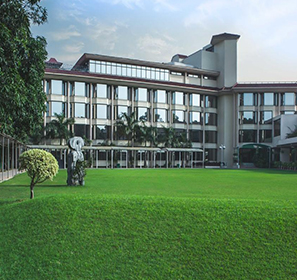
Perhaps a major part of the city
s modernity emanates from the fact that there is a very large body
of youthful student population. The hub of its activities is the
beautiful Panjab University campus with its impressive red sandstone
buildings laid out amid gardens, water pools, and fountains. The
idyllic campus surroundings inspire academic learning, scholarship
and cultural enrichment. Besides the university, there are also
many other premier institutions of medicine, engineering, architecture
and science located in the city.
The other dominant species of the
city populace is the Government servant-retired or serving. With
the presence of two State Governments of Punjab and Haryana, and
the third one of Chandigarh Administration, the city abounds with
babus and bureaucrats and clerks in cars or on cycles.
Attractions
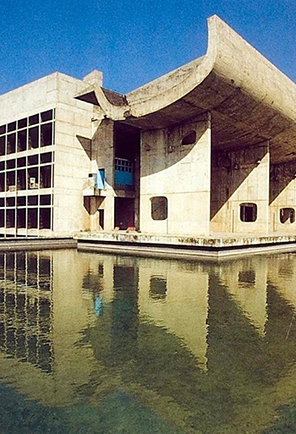
In terms of attractions, the first thing that comes to mind
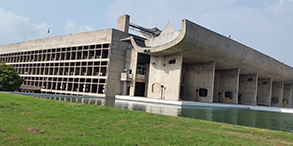
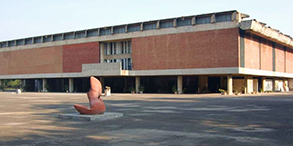
is the monumental Capitol Complex, which dominates the city skyline.
Standing aloof, like the Greek Acropolis, at the foothills of the
city, the geometrical concrete buildings rise from the mounds as
giant playful sculptures. The three major buildings comprising the
Capitol Complex are the Secretariat, the Assembly, and the High
Court. All the three are interlocked to one another as part of a
subtle visual composition, delicately balanced and enclosing grandiose
spaces. Between the silhouettes of these magnificent edifices is
juxtaposed the city s most popular visible symbol: the Open Hand.
Conspicuous as a giant hand in steel, it rotates free with the whims
of the winds from a high concrete pedestal, conveying the message:
open to give, open to receive.
Next to the Capitol Complex, the
most important place to visit is Sector 17, its sleek shopping area
and the city center. Planned around four pedestrian concourses meeting
at a central Chowk, it is a pedestrian s paradise, dotted with fountains,
sculptures, and groves of tree. In summer one can move from one
end of the sector to the other under the shade of a corridor, and
in winter it is nice to be out in the sun-drenched piazzas. In the
evenings, when the colorful mosaic of neon signs and the aesthetically
illuminated fountains come alive, it becomes the city s biggest
outdoor club. And the people congregate there for the thrill of
the urban rub and the excitement of its shop-front glitter.
A major feature of Chandigarh is
its Leisure Valley, which, like a garland of gardens, ornaments
the city from one end to the other. A natural eroded valley of the
city site with a small gurgling rivulet has been now developed into
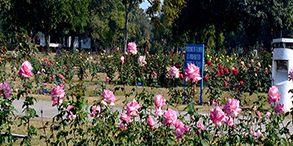
a series of theme gardens. The most famous of these is the Rose
Garden. The other prominent parks of the city are the Garden of
Tranquility, Garden of Rare Plants, Garden of Annuals, and the Bougainvillea
Garden.
No description of Chandigarh gardens
can be complete without a mention of its most celebrated creations,
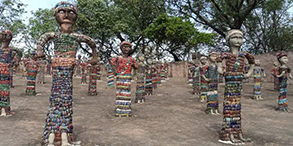
The Rock Garden. Spread over 12 acres of wooded land near the Capitol
Complex of Le Corbusier, it is the creation of a humble former road
inspector: Nek Chand. Turning urban waste material into creative
patterns and textures, his touch transformed mute rocks into art
objects. Mysterious spaces with stones, rocks and waterfalls recreate
the awe and wonder of primordial nature. This unabashed realm of
natural and manmade creativity attracts people of all age groups,
and from all parts of the world.
Another favorite recreation spot
of the nature-loving people of Chandigarh is the Sukhna Lake. Created
by building an artificial dam on a seasonal stream, it is spread
over a large area. A two-kilometer-long promenade along the lakeshore
is a popular place for strolling. On any day, early in the morning,
fitness buffs of all age groups can be seen walking, jogging, and
performing yoga or vigorous exercises at the lakefront.
Fairs And Festivals
However, it is not bricks, stones and trees alone that infuse
breath into the city s soul. It is essentially the people and their
ethos that etches the image of a city. Although, the planning of
Chandigarh was not intended to be a social revolution, it has nevertheless
shaped the psyche of its people-who are more secular, integrated
and modern in their outlook. They are also fiercely proud and possessive
of their city.
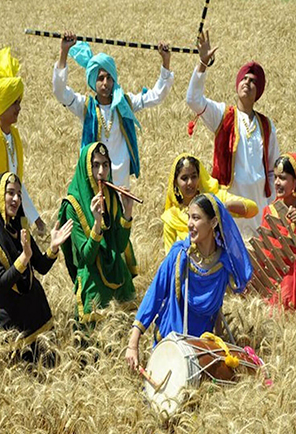
Lacking in age-old cultural traditions
of a typical town, Chandigarh has acquired new ones to its calendar
of activities. People celebrate spring festivals, tree plantation
festivals, rose and chrysanthemum shows, dog shows and kite-flying
festivals with as much gaiety and zest as they celebrate Diwali,
Holi or any other religious function. Chandigarh citizens are also
a very culturally conscious. For a small city of its size, there
are more than five major auditoriums and a same number of art galleries.
Even more and bigger cultural centers are being planned to be built
to cater to the growing demands of art and theater lovers. In autumn
and winter when the sun is mellow, on a single day there can be
a good number of art exhibitions and concrete openings in the city.
It is usual for the city elite to be seen and to see such occasions
as an important status symbol.
In the final analysis, what makes
Chandigarh extraordinary is the fact that merely within four decades
a barren landscape has been transformed into a modern and model
human habitation. The making of a new city is like inventing a new
tomorrow. And Chandigarh succeeds in ushering in a new dawn.
PLACES NEARBY
A visit to Chandigarh is not complete without a visit to the
temple of Goddess Chandi, which is located in Panchkula, 10 km away
from Chandigarh. In fact, the name Chandigarh is derived from this
temple. Nearby is the temple of Mansa Devi. Both the temples are
built in the North Indian style of architecture. Moreover, there
is the Panchkula Cactus and Succulent Botanical Garden, which houses
over 2,500 varieties of cacti and other succulent plants from all
parts of the world. This is the first and the only botanical garden
where a systematic and comprehensive collection of Indian species
of cacti is being.
Located on the banks of River Ghaggar,
15 km from the city, the Chattbir Zoo is an ideal getaway from Chandigarh.
The zoo lies on the Chandigarh-Patiala Road. Besides these, Pinjore
(now Yadavindra Gardens; 20 km), Morni Hills (45 km), Kasauli (77
km), Chail (107 km), and Shimla (110 km) are some of the interesting
places to visit around Chandigarh.
Area: 69.63 sq km
Population: 5,10,565
Languages Spoken: Punjabi, Hindi, English
Religion: Hinduism (74.61%), Sikhism (19.78%), Others (5.61%)
Maximum Temperature: 42.40 C
Minimum Temperature: 3.40 C
STD Code : 0172
HOW TO REACH
By Air
Chandigarh is connected to Delhi (daily) and Amritsar (bi-weekly)
by flights of Indian Airlines. There is also a weekly flight to
Leh from Chandigarh. Jet Airways has daily flights to Chandigarh
from Delhi. The airport is 11 km away from the main city. Taxis
and auto-rickshaws are readily available for the airport.
By Rail
The railway station is 7 km away from the city center. It is
well connected to the major cities of India like Delhi (238 km),
Bikaner (575 km), and Jodhpur (827 km).
By Road
Chandigarh is well connected by road to almost every small
and big town in northern India. Frequent buses ply from Chandigarh
to Punjab, Delhi, Haryana, Himachal Pradesh, Jammu and Kashmir,
and even Rajasthan. One has a varied choice that includes luxury
buses, ordinary buses and taxis, all of which are readily available. |