|
There
is a famous Bengali saying 'Baro mashe tero parbon' which
literally translates as 13 festivals in 12 months. This famous Bengali
saying however grossly underestimates the number of festivals, civil
and religious, celebrated in Kolkata, where communities belonging
to all religions and from all over the subcontinent have brought
along their own local cults which even within the Hindu religion
vary from area to area.
New
Year's Day
The first festival of the year in West Bengal is the New Year's
Day. Although most communities follow their own calendar, the first
day of the Christian year is celebrated by all. Buses are garlanded.
The state is in a festive mood, with decorations from Christmas
past still very much in evidence.
As year come to an end the people of West Bengal and get ready to
mark the beginning of another year. On the night of 31st December,
which is usually chill due to peak winter people forgetting the
cold are seen to move around the side walks of Park Street through
out the night merry making to glory. On New Year's Eve, parties
are organised in clubs, hotels, restaurants and private homes. People
go to bed late. Those who manage will go to the races the next day
in the afternoon-a hangover 'must' in Kolkata.
Gangasagar Mela
Is the largest fair celebrated in West Bengal. This fair is held
where the Ganga and the Bay of Bengal form a nexus. Hence the name
Gangasagar Mela.
The river Ganga which originates in the Gangotri glacier in the
snow clad Himalayas, descends down the mountains, reaches the plains
at Haridwar, flows through ancient pilgrimage sites such as Benares
and Prayag, and drains into the Bay of Bengal. for
more info on ganga sagar mela click here ...
Makar
Sankranti
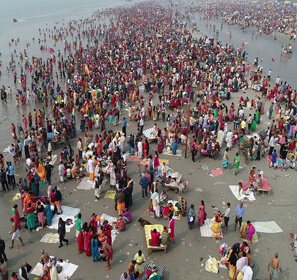
The Makar Sankranti festival which falls in mid-January and
marks the winter solstice. During this period pilgrims in numbers
more than 500,000 gather on Sagar Dwip, an island some 150 kilometers
(93 miles) south of Kolkata, for the three-day Ganga Sagar Mela.
The pilgrims on the way to the mela sleeps in make shift tents erected
in the Maidan . The festival lasts from 12th to 14th. The Baul Mela
beings on the day the Ganga Sagar Mela ends. Bauls are singers
belonging to the Hindu Vaishnab and Sufi Muslim from all over Bengal
as well as from Bangladesh. They gather at Bolpur which is 150 kilometers
(93 miles) west of Kolkata and sings enchanting devotional tunes
for three nights
Saraswati
Puja
Late in January or early February, Saraswati Puja, the festival
of Goddess of Learning, is celebrated by students, artists and professors.
As the winter recedes and spring approaches, the city get ready
for the celebration of Vasant Panchami. On this day primarily students,
artists and professors offer worship to Devi Swaraswati the Goddess
of Knowledge and music.
Dol
Purnima
Dol Purnima more popularly known as Holi is a festival of colours
and the city celebrates it with the traditional gaiety. Holi is
also known as the Dol Yatra in Bengal. It is celebrated by people
of all walks of life both young and old by smearing each other with
coloured powder especially red. Colours are also mixed with water
and sprayed on passer-by. The ever enthusiastic group enjoys by
drinking bhang which is a mild-milk beverage laced with marijuana.
Social barriers are broken. This is a time when lower-cast plays
with the upper-cast and poor may play with the rich.
Noboborsho
Marking the beginning of the Bengali New Year is Noboborsho. It
falls on the mid of April the approach of summer. Bengali businessman
opens his new account book the halkhata. The account books, statues
of Ganesh and Lakshmi is taken to the Temple for blessings. The
businessmen invites their loyal customers in the evening who make
a token payment to open the new account book. The shops are heavily
decorated with floral garlands, young banana and auspicious mango
leaves and the customers are greeted with sweets.
A few days after noboborsho, on Mahabir Jayanti, the birth anniversary
of last and greatest Jain prophets, there are processions of the
Svetamber Sect from Harrison Road to Kalakar Street, and of the
Digambar Sect from Belgachaia to Baisakh Lane.
Rath
Yatra
The Rath Yatra festival falls on the late of June or early July.
It is celebrated in the honour of Lord Jagannath an avatar of Vishnu.
Processions are organised in Kolkata by the ISKON and in Serampore,
north of Kolkata. People scramble around to get a chance to pull
the sacred rope of the huge chariot. Replicas of Jagannath's chariot
are sold at Kalighat. Children decorate their chriots with flowers
and place in them clay images of Jagannath, his brother Balaram
and sister Subhadra.
Vishwa
Karma Puja
Vishwa Karma is the God of Creation. On the 17th. September
every year the festival is celebrated by all industrial houses,
artists, craftsmen, and weavers. The tools utilized during production
are cleaned and all machinery are repainted. The the statue of Vishwakarma
holding a hammer are erected in workshops. People are also found
to be flying multi-colour kites.
Durga
Puja
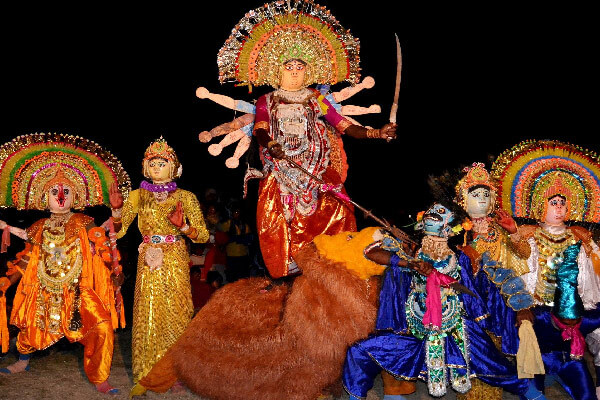
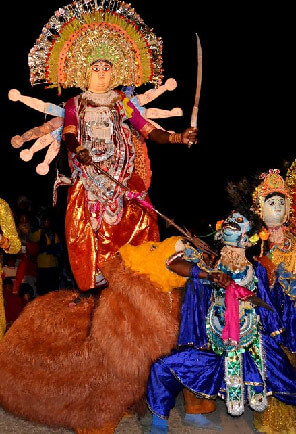
The start of winter coincides with Durga Puja in October, the most
important festival in Bengal. According to Hindu mythology, all
gods and goddesses of thee Hindu pantheon endowed Durga with a portion
of their own energy to give her strength, or shakti, to destroy
the evil forces. Some 2,000 pandals are erected throughout the city.
The image of Durga shows her slaying the most powerful demon, Mahisasur.
for more infromation
on Durga puja click here...
Laxmi
Puja
In the month of October, five days after Mahadashami, on full moon,
is the festivals of the Goddess of prosperity Laxmi who is worshipped
daily in most Hindu household for the family's well-being. Public
Pujas are performed in the same premises as for Durga Puja.
Kali
Puja
After nineteen days of the completion of the Durga Puja, the city
get geared up to celebrate another popular festival, the Kali Puja.
Kali is worshipped as the Mother Goddess who protects from evil.
The image of Kali is bit frightening and usually shows her with
a severed head in one hand, her sword known as Kharga in the other.
She is seen standing on her foot on Lord Shiva's chest and wearing
a garland of skulls. The puja actually takes place at midnight on
the day of the new moon. During the Kali Puja all houses are lit
up with candles decorated around the house. During this puja, children
and adults are seen to burst firecrackers and lighting multicouloured
sprinkling crackers. No one seems to sleeps on that night.
Kali Puja coincides with Diwali, the North Indian New Year, the
festivals of lights. House-holds clean their houses and light up
candles all over their houses. Children and adults set off firecrackers
all night. No one sleeps on that night.
Two days after that is Brother's Day, Bhai Phonta or Bhatri Dvitiya.
Elder sisters dip their little fingers into kajol, a mixture of
ghee, rice-paste and almond paste, and put a mark on their brothers'
forehead.
Christmas
Christmas is not only celebrated by the Christian community but
even other people and communities of Kolkata as well. The famous
Park Street is highly illuminated and Flurry bake specials cakes
which is sold in no time. Christmas falling during winter which
is a very pleasant time of Kolkata, people are seen taking time
off to hold picnics. There are parties in clubs and hotels. The
best masses are at St. Paul's Cathedral, candle lit on this occasion,
at St. Andrew's Kirk.
The
Muslim Festivals
Muslim festivals are celebrated with intensity in West Bengal. During
Bakrid, marking the end of Ramazan and Id-Ul-Fitr in celebration
of the hajis, the pilgrims to the Holy Mecca, the northern part
of the Maidan becomes the prayer grounds for Muslims who gather
around the Saheed Minar while the muezzin leads the sessions from
the top the monument.
The Shiite processions along Chitpore Road and, in Metiaburuz, Kidderpore,
Razabazar, Narkeldanga, Beliaghata and Manicktola are really a spectacle
to be seen. These procession are led by a white horse, the Hussain's
mount. Immediately following are the tazias, preciously handicrafted
replicas of Hussain's grave. The flagellants pound their chests
singing "Hassan, ya Hussain" and use muti-tailed whip
attached with razor flagellate themselves.
Jalpesh
Mela (District Jalpaiguri)
On the occasion of Sivaratri (February March), a month-long
fair is held at Jalpesh near Mainaguri in the district of Jalpaiguri.
The fair centres round the age-old Siva temple dedicated to Lord
Jalpeswara.
Bera
Utsav (District Murshidabad)
Every year on the last Thursday of the Bengali month of Bhadra
mid-September, Bera Utsav is held at Lalbagh on the river Bhagirathi
near the palace of the Nawabs. Fireworks of various size and colour
add to the gaiety of the festival.
Jagaddhatri
Puja (District Hooghly)
Goddess Jagaddhatri is worshipped in the Bengali month of Kartick
(November). At Chandannagar near Kolkata images of the goddess are
tall, pandals spectacular and the illumination unique. In fact,
the illumination part is the most attractive feature here.
Teesta
Tea & Tourism Festival (Inter-State)
Held in a series at Darjeeling, the Dooars and in Sikkim, the
Teesta Tea & Tourism Festival is celebrated with a view to promote
tourism in this region as a composite tourist destination, with
its bounties in tea, timber and tourism. The festival is held every
year in November December.
Vishnupur
Festival (District Bankura)
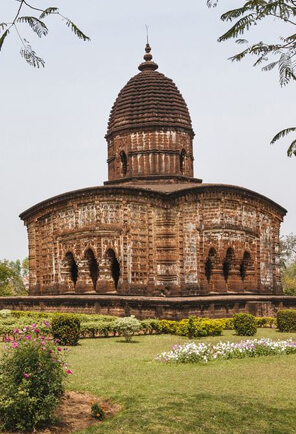
In the temple town of Vishnupur a festival is organised every
year between 27 and 31 December. Characterised by exhibition and
sale of local handicrafts and performance of the rich musical tradition
that Vishnupur boasts, this is an immensely popular festival. |