Overview
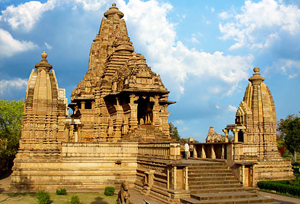
A very famed heritage city in Madhya Pradesh, Khajuraho is known for housing several Hindu and Jain temples. A popular UNESCO world heritage site, Khajuraho will simply astonish you with its unique temple carvings which are lined in symmetry including the finest sandstone carvings and erotic sculptures. A number of tourists from all across the world flock this place to ideate the immortal saga of Hindu art and culture etched in stone.
Khajuraho was earlier the cultural capital of Chandela Rajputs who ruled this part of India during 10th to 12th centuries. Built over a span of 200 years (950-1050 AD), there were around 85 temples during that time which reduced to 22 and now it's preserved by the State Government. Sprawled over an area of approx 20 sq.km in the northern eastern part of the state, Khajuraho is a popular tourist destination which are categorized into three sections including western, eastern and southern temples.
The temple is a perfect example of Indo-Aryan architecture as the sculptures highlights several facets of Indian life thousand years ago. Lovely stone friezes of gods, goddesses, heroes and kings, concubines, and many more would hail you as you journey to Khajuraho. The erotic sculptures of this place portraying Kama Sutra are completely unique in the world. Above all, it reflects a unique architectural talent which depicts royalty, courtship, marriage, spiritual teachings, meditation, kinship and intimate scenes of human emotions and relationships. You may also enjoy watching the folk dances, light and sound shows, organized in the temple premises and other art centers. So, be it the erotic carvings or the evening shows, you're adhered to be stunned by the grandeur of Khajuraho temples.
Interesting facts
- Khajuraho is the UNESCO World Heritage Site.
- It vaunts rich cultural heritage and glorious past.
- Khajuraho is popular for its erotic sculptures which beautify the temples.
- Khajuraho name is derived from the Hindu word ‘Khajur’ that means ‘date palm’
- There were around 85 temples at Khajuraho which devolved due to the damages of the nature and so now there are only 22 Hindu temples left now.
- Khajuraho Temple was constructed during the rule of Chandel Empire (950 and 1050 AD).
- The beautiful temple of Khajuraho embodies the manifestation of a highly matured civilization.
- Khajuraho temples are ranked as the best monuments of antiquity by Archeological Survey of India.
- The images of Goddesses and Gods carved on the temple show off many expressions of the divine Shiva and Shakti.
Things to Do and See in Khajuraho
- Head towards the Western Group of Temples in Khajuraho including Lakhmana Temple, Kandariya Mahadeo Temple, Devi Jagdamba Temple, and Chaunsat Yogini Temple; where you'll be enthralled viewing the unique architecture and dazzling ornamentation of the temples.
- After exploring the western group of temples, move towards the Eastern Group of Temples where you get to see the lavish architecture and sculpted figures at Parsvanath Temple, Ghantai Temple and Adinath Temple.
- While temple bound to leave you speechless during the day, don't miss the colorful Light and sound shows at Western group of temples. It's an evening musical show which begins with a voice-over by the fabled Bollywood Actor Amitabh Bachhan.
- You should not miss to explore the Southern Temples which house a large Vishnu statue.
- Rejuvenate yourself at Archanta Yoga Ashram where classical Hatha Yoga Classes are followed in a traditional ashram lifestyle.
Where to Stay in Khajurhao
- Ramada Khajuraho
- The Lalit Temple View
- Eurostar Inn
- Radisson Jass Hotel
- Hotel Isabel Palace
- Hotel Surya
- Hotel Harmony
- Hotel Zen
- Hotel Marble Palace
- Shri Krishna Jungle Resort
Festivals and Events
Tourists can enjoy the festival of Classical Dances in Khajuraho which is held every year in the month of February and March. In this week-long festival, you'll love to encounter the seven classical dances of India which are performed by famous dancers of the India. The dances which are performed during this festival include various Indian classical dance genres like Manipuri, Bharat Natyam, Oddissi, Kucchipudi, Mohiniattam, Kathak, and Kathakali.
Shopping in Khajuraho
Khajuraho is a famous destination in India that draws a number of tourists from all across the world. Shopping here can bring a pleasant experience if you know from where to shop and what to buy. There are various handicraft stores and Crafts Emporium from where you can buy various sculptures of brass, iron and stone. On Tuesday, a weekly bazaar is also held at Rajinagar (5 km from Khajuraho) where you get a huge collection of brass and silver items at economical prices. Including these, you can also choose to shop at Oswal Complex and City Center in Khajuraho.
How to Reach
By Air: Civil Aerodrome Khajuraho Airport in Khajuraho is the nearest airport (Approx 6 Km) that connects several cities of India like Mumbai, Kolkata, Bhopal, Varanasi, and Delhi. Travellers from abroad can get flights from Mumbai and Delhi.
By Rail: Khajuraho Railway Station (5.9 Km) is the nearest railhead top reach the destination. Other nearest railhead is Mahoba Railway Station which is located at the distance of 63 Km from Khajuraho.
By Road: There are various private buses which ply from Khajuraho to several other cities. Major cities like Jhansi, Satna, Harpalpur, Jabalpur and many more are well connected to Khajuraho by road.
Best Time to Visit: September to March