The
helicopter skimmed across the lagoon, the turquoise waters only
partially hiding the formations of coral rock. In seconds, the
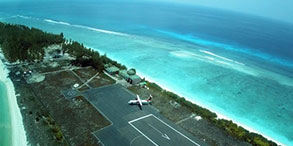
island of Agatti with its ribbo
n-like
runway was a speck behind us. Below, the colors were changing
rapidly, for beyond the coral reef the pale blue had changed to
a deep blue where the currents of the sea threw up white capped
waves. Then suddenly, the sea below seems to start frothing and
I draw the pilots attention to it, who pushes back his headset
and yells, Tuna!
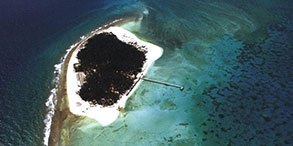
The Lakshadweep islands are the only real coral islands in the
country. They almost seem to float out of nowhere some 400 kilometers
from the coast of Kerala and of the 36 islands, only ten are inhabited.
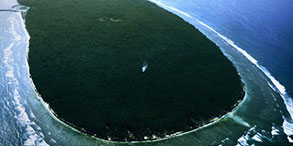
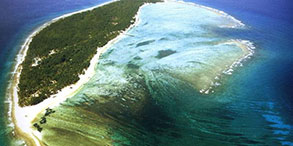
Most of them are long and irregular with a lagoon enclosed by
a coral reef usually on the western side. Believed to have been
formed as a result of coral activity, each lagoon abounds with
some spectacular growth of corals, which in turn supports a diverse
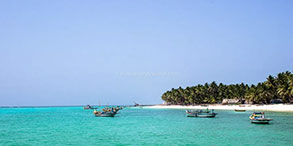
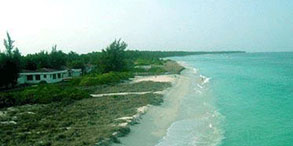
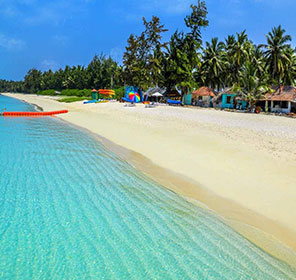
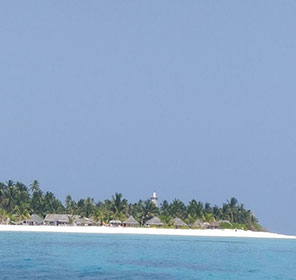
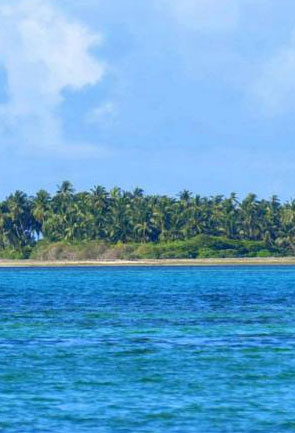
array of marine life. The tiny, narrow islands with their coconut
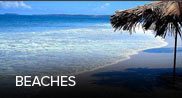
palms, white coral beaches and lovely, shallow and clear waters,
combine to make it a tropical dream, which few parts of the world
can match.
The
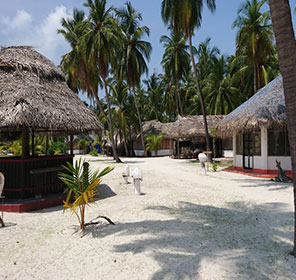
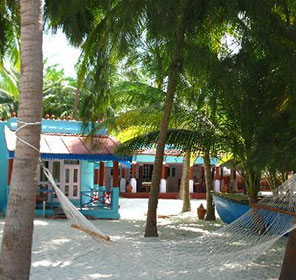
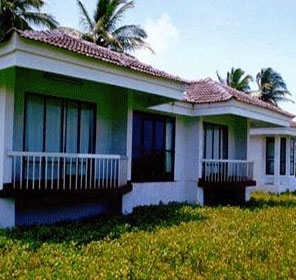
island of Bangaram lies below us and we sweep around it, peering
through the canopy o coconut trees at the tiny cottages and the
colourful boats lines up next to the lagoon. The engine seems
to quieten down a bit and the helicopter touches down smoothly,
its rotors whirling up gusts of coral sand which forces the spectators
to turn their backs. We jump out, dragging our bags from the hold
and then the helicopter is climbing again, angling across the
lagoon and racing off to Agatti. It takes a couple of minutes
to walk across the width of the island, and after being welcomed
with large coconuts we are shown our rooms.
The
lagoon feels like a huge, endless swimming pool and we try to
get a feel of the snorkels and the flippers, which often turn
one upside down in the water. An hour later, we are racing across
the lagoon in a flat-bottomed boat powered by powerful outboard
motors heading for the reef. Jose Dominic, the quiet and soft-spoken
man behind Bangaram has talked endlessly of snorkeling ever since
we left Cochin together, but nothing had prepared us for the sudden
explosion of colour as we lowered ourselves into the water near
an old shipwreck off Bangaram.
In
seconds, one has become a snorkeling addict. Fish of various hues
and sizes seem to accept us as part of their world. Soon everyone
is surfacing and sending everyone to the spot theyve just
emerged from. Huge corals breathe, while thousands of brilliantly
colored fish swim in all directions. At the edge of the wreck,
a shadow startles me and I turn to face a read snapper, longer
than my arm as it glides past. A smaller, almost transparent fish
nibbles at my legs, and as I get more used to the mask and the
snorkel, I begin to dive a little bit. The first piece of basic
equipment is the facemask, which acts as the magic window through
which one can see the secrets of the underwater world. By forming
an airtight seal around the eyes and the nose, it creates an air
space between the eyes and the water, eliminating the blurred
vision, enabling us to see as clearly as on land. On the other
hand, water magnifies things and they appear four times larger
and one-fourth closer to you than they actually are. And to cap
it all, one need only be a casual swimmer to get going, the flippers
giving one the power to move in the water with great ease.
Back
on the island, Mr. Walto and his staff took over. Dinner usually
boasted a menu drawing heavily on the waters outside the lagoons
with the famous Lakshadweep tuna, squid and other seafoods fining
their way to the table. Coconut cultivation and fishing being
the chief occupation of the people, both these items dominate
the cuisine and in Bangaram, the mix of local and continental
dishes caters to a wide variety of tastes. Like the cuisine, the
resort too blends with the local styles. The emphasis on preserving
the fragile ecology of the coral islands is almost a mania for
the local administration for the way in which it carries the local
people with it in its decisions.
In
keeping with the planned and phased development of the islands,
the island of Bangaram was chosen as the venue for the resort.
Until then uninhabited, mainly because of the lack of drinking
water, stringent guidelines were set and hoteliers were asked
to submit proposals. Dominics Cochin based Casino Hotel
was eventually invited to Bangaram and the resort got underway.
Besides offering exquisite beaches and lagoons, Dominics
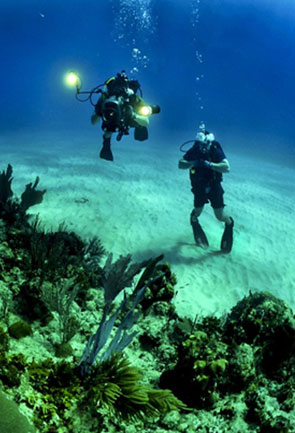
emphasis is on the water sports. While snorkeling is confined
to the shallower areas within the reef, his aim is to get to the
corals outside the reef where deep sea diving will help people
explore the cliffs on which the islands are perched. Far more
specialized equipment and trained instructors are being brought
in and that will open up a new exciting avenue altogether.
Deep-sea
fishing, using local modified boats, is another spot lined up
for the near future. The yellow finned tuna runs upto a hundred-odd
pounds, and the tropical waters also abound with the greatest
sporting fish of the sea- the marlin. Standing on the reef on
a subsequent day, we watched a fishing boat chase a school of
tuna, and later from their hold they held up a reasonable sized
black marlin. Our guide had grinned when we asked him how they
landed that big a fish and simply said hand line.
I dont think Hemmingway would have gone to Cuba had he know
that!
The
next day Dominic took us fishing. To start with, we used bits
of squid to catch manyan, a small yellow fish with blue stripes
not bigger than the size of ones hand. With a reasonable
haul, we then set off to look for a couple of octopuses, which
was easier said than done. Using snorkels, our local guides dived
into the water, carrying a couple of iron rods. For the next half
an hour or so they thrashed around and occasionally surfaced with
an octopus wrapped around their iron rods. It was a painful and
tedious business, for the octopus would dart into a hole and no
amount of tugging could get it to release its tenacious hold.
Eventually, with three small octopuses in the boat, we set off
for the reed where the tide was beginning to come in.
On
the outer side of the reef the sea looked frightening - grey blue
with angry waves which were in sharp contrast to the tranquil
waters in the lagoon even though we were so far out that one could
only see the island way of in the distance. After dropping anchor,
bits of the octopus and the manyan were threaded onto the hook,
and then, legs straddling the boat, our guides would rotate the
bait over their heads like the rotors of a helicopter, pick up
sufficient momentum and then let the lines ink out.
Hand
line fishing is something else. There is no rod to break the fishs
run, no reel or drag to control the pull but ones bare hands
which can grip the nylon lines tentatively at best for a running
fish of a few pounds can singe the hands badly. As it were, we
ran into fair number of snappers, and towards the end were catching
fish well over ten pounds with relative ease, while our guides
seemed to be after even bigger fish. After dark, fishing in the
lagoons seemed to improve, and the darkness added to the excitement
for one had no idea what was at he other end of the line until
it was actually hauled into the boat. Then, with our speedboats
throwing up a luminous green in their wake, we would open our
throttles and race back to Bangaram.
The
ease with which one can slip into any activity is a major plus
point in Bangaram. To explore the corals, a non-swimmer can set
off in glass bottom boat or just zip around the lagoon, in the
speedboats. To get away from it all on ecan spend ones time
wind surfing, or kayaking or just getting lost on the island whose
total circumference is four kilometers.
Even
though Lakshadweep comprises a group of islands, they are often
miles apart and a journey from one to another by boat or ship
could take anything between three to twenty hours. The availability
of a helicopter service simplifies things tremendously, and also
sometimes gives a distorted picture to the visitor who can fail
to appreciate the isolation in which the people have lived over
the ages. Little is known of the early history of the archipelago,
but it appears that before the 7th century, the population was
entirely Hindu. They were converted to Islam by Hazrat Ubaidullah
who set off from Mecca after Prophet Mohammed appeared to him
in a dream and commanded him to sail for distant lands to propagate
Islam. After being shipwrecked he drifted to the island of Amini
where, after initial opposition, he was able to carry out his
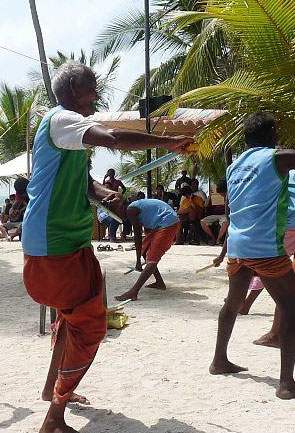
mission. To date, the folk ballads sing of the arrival of Hazrat
Ubaidullah in Lakshadweep and of the plunder of the islands by
the Portuguese and other events.
The
people even today remain unaffected by the changes taking place
in the rest of the world. Mr. Habibullah, the Administrator of
the islands tells the story of a tea-stall owner who was approached
by the Administration to expand his business. On behalf of the
government they offered to set up a larger business for hi, the
proceeds of which would go entirely to the tea-stall owner. The
man was adamant, refusing to expand his business, regardless of
any additional profit. There is also virtually no crime in the
islands, the most obvious testimony to which is the profusion
of gold worn by the women and it is not an uncommon sight to have
little children race past sporting chunky bits of gold jewellery.
Other
than Bangaram, another four islands are open to Indian tourists.
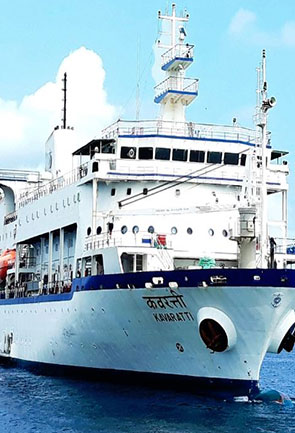
The most developed of these is the Administrative capital, Kavaratti
that is very densely populated. The island boasts of 52 mosques
spread out among the coconut groves and the most beautiful of
these is perhaps the Ujra mosque whose ornate ceiling is said
to have been carved from a single piece of driftwood. Kavaratti
also has an aquarium with several colourful species of fish and
the corals, which give us a background to what the lagoons to
what the lagoons are all about.
There
are tourist huts at Kadmat Island, which has a large lagoon of
even depth. Kalpeni has three uninhabited satellite islands, all
surrounded by a lagoon of spectacular beauty. This lagoon is particularly
rich in coral life and naturally lends itself to snorkeling. Minicoy,
the largest and southern most island has the largest lagoon and
is also known as a womens island, the society
being completely matriarchal. Minicoy also has a culture very
different from the other islands, as it was located on the major
sea routes where contact with the outside world was greater. Even
today, its men are mostly sailor working on merchant vessels.
Though
the main islands are heavily populated, the isolation on the smaller
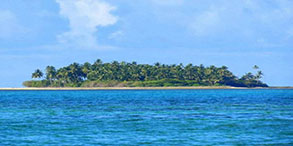
uninhabited Islands has to be experienced. Off Bangaram, are two
satellite islands, Pirali One and Pirali Two. It takes the twin-engined
speedboat half an hour to skip across the lagoon, zig-zagging
to avoid the corals, which look like mushrooming giants underwater.
A local fishing boat has just left, leaving strips of tuna to
dry on the beaches. Hermit crabs scuttle off at our approach and
the area is littered with large blue shells of lobsters. The reef
runs right upto Pirali One where hundreds of crabs cling to the
coral as the angry sea tries to pluck them off. The lagoon is
sandy and shallow and like Robinson Crusoe we too would like to
run on the beach but the bits of dry coral cut into the feet and
make walking difficult. Just the, under the coconut trees, we
come across an edict that proclaims to any intruders from the
sea that this is the Indian Territory.
Time
rolls on. The tranquility and the beauty of the islands leave
their permanent impression and to go back to the coral beaches
becomes a dream. Days, months after I sit in a darkened auditorium
and listen to the leader of the Trishna Expedition as he describes
their travels around the world in a sailing boat. Pictures flash
on the screen and we drift with the speaker
through Africa,
Europe and the Windies. Visions of grass skirted dancers and the
Australian Barrier Reef. Then, from somewhere in the dark, the
inevitable question
which was the most beautiful place?
To each, its own, says the speaker, but if he had to choose, he
would settle for those tiny islands in the sun
the Lakshadweep
Islands.
Entry
permit
All visitors to the Islands of Bangaram Resort will need
a permit. These are issued at Cochin. It would therefore be necessary
to send three passport size photographs with full passport details
to the management of Bangaram Resort to obtain the permit in advance
in the case of foreign nationals. In the case of Indians only
name and address required. Permits are ordinarily issued with
a validity of 15 days. If required this may be extended from the
resort itself. While advance arrangement for the permit would
be desirable, this permit can also be arranged on arrival at Cochin.
Prohibition
Prohibition is in force in all the islands except Bangaram.
A well stocked bar is available on the resort. Tourists are prohibited
from carrying alcoholic beverages even while transiting through
Agatti.
Medical
facilities
A Health Centre with qualified medical personnel is available
at Agatti.