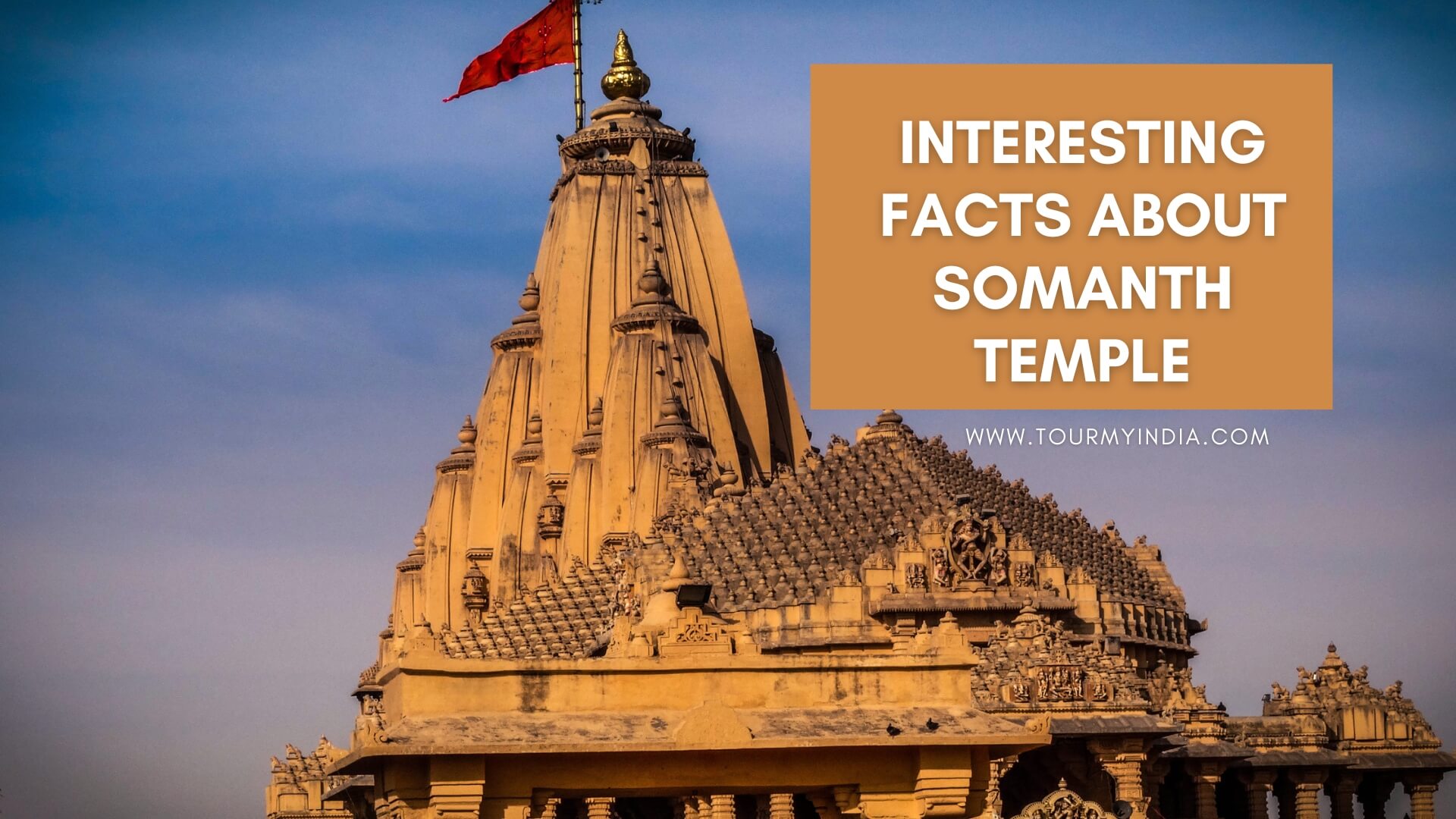
One of the 12 Jyotirlinga shrines of Lord Shiva, Somnath Temple is also a fine specimen of architectural brilliance. Dubbed the “Eternal Shrine,” it is believed to be the place where Lord Krishna ended his earthly lila and departed for his heavenly abode. This legendary temple is said to have been vandalized numerous times throughout history, but with the support and devotion of Hindu kings, it was rebuilt each time.
Also Explore: Popular Gujarat Tour Packages
In this blog, we bring you some fascinating facts and legends associated with this sacred and architecturally magnificent temple:
- The modern-day Somnath Temple was built over a period of five years, from 1947 to 1951, and was inaugurated by the then President of India, Dr. Rajendra Prasad.
- The Shivalinga in the temple is believed to have safely hidden within its hollow interior the famous Syamantak Mani, the Philosopher’s Stone associated with Lord Krishna. It is said to have been a magical stone capable of producing gold. It is also believed that the stone possessed alchemical and radioactive properties and could create a magnetic field around itself, allowing it to remain suspended above the ground.
- The temple finds mention in some of the most ancient Hindu texts, including the Shreemad Bhagavat, Skanda Purana, Shiva Purana, and the Rig Veda, signifying its importance as one of the most revered pilgrimage sites in India.
- According to historians, Somnath has been a pilgrimage site since ancient times as it is believed to be the confluence of three rivers—Kapila, Hiran, and the mythical Saraswati. This confluence, known as Triveni Sangam, is believed to be the place where Soma, the Moon God, bathed and regained his lost lustre. This legend is associated with the waxing and waning of the moon and, symbolically, the changing tides along the seashore.
- Legend has it that the original structure of the temple was first built by the Moon God using gold. The Sun God later rebuilt it in silver, while Lord Krishna reconstructed it using sandalwood.
- According to Hindu scholar Swami Gajanand Saraswati, the first temple was built 7,99,25,105 years ago, as derived from the traditions mentioned in the Prabhas Khand of the Skanda Purana.
- The temple suffered destruction at the hands of Mahmud of Ghazni in 1024 CE, Alauddin Khilji’s army in 1296 CE, Muzaffar Shah in 1375 CE, Mahmud Begada in 1451 CE, and Aurangzeb in 1665 CE.
- The temple is believed to be situated at a location where there is no landmass in a straight line between the Somnath seashore and Antarctica. An inscription in Sanskrit on the Arrow Pillar, known as the Baan-Stambh, erected on the sea-protection wall of the temple, states that Somnath stands at the first point of land on that longitude from the north to the South Pole.
- According to the Skanda Purana, the name of Somnath Temple changes every time the world is recreated. It is believed that when Lord Brahma creates a new world after the destruction of the current one, Somnath will be known as Pran Nath Temple.
- Along with Lord Shiva, sculptures of Lord Brahma and Lord Vishnu can also be seen on the temple walls. According to the Prabhas Khand of the Skanda Purana, while answering a question from Goddess Parvati, Lord Shiva reveals that Somnath has been known by eight different names so far.
- According to another reference in the Skanda Purana, there have been six Brahmas before the present one. This is believed to be the era of the seventh Brahma, known as Shatanand. Lord Shiva also reveals that in the seventh Yuga, the temple is called Somnath, while in the previous Yuga, the Shivlinga was known as Mrityunjay.
This sacred shrine continues to be one of India’s most important pilgrimage destinations, revered not only for its spiritual significance but also for its rich history, fascinating legends, and remarkable resilience through the ages.
Other Interesting Blogs to Read


 +91-9212777225
 Plan Your trip