Nashik Kumbh 2027 Amrit Snan Dates
| Amrit Snan |
Date |
Location |
| First Amrit Snan |
August 2 2027 (Ashadh Somvati Amavasya) |
Nashik & Trimbakeshwar |
| Second Amrit Snan |
August 31, 2027 (Shravan Amavasya) |
Nashik & Trimbakeshwar |
| Third and Final Amrit Snan |
September 11, 2027 |
Nashik |
| Third and Final Amrit Snan |
September 12, 2027 |
Trimbakeshwar |
Other Sacred Bathing Dates of Nashik Kumbh Mela 2027
| Parva Snan |
Snan Date |
| Rishi Panchami |
September 5, 2027 |
| Bhadrapada Shukla Ekadashi |
September 11, 2027 |
| Bhadrapada Purnima |
September 15, 2027 |
| Ashwin Shukla Ekadashi and Purnima |
October 11 and 15, 2027 |
| Kartik Shukla Ekadashi and Purnima |
November 10 and 14, 2027 |
| Ganga Dussehra Festival |
May 25 to June 2, 2028 |
| Maha Shivratri |
February 27, 2028 |
| Vasant Panchami |
February 1, 2028 |
| Mauni Amavasya |
January 26, 2028 |
Note : The revered Ganga–Godavari Festival will take place on 8 February 2028.
Understanding Simhastha
The term "Simhastha" refers to a specific astrological alignment, when Jupiter enters Leo (Simha Rashi). In Hindu cosmology, this moment is believed to activate sacred rivers, making ritual bathing an act of exceptional spiritual potency.
Unlike calendar-based festivals, the Simhastha Kumbh is governed by planetary precision. Rituals, processions, and bathing sequences are aligned with cosmic timing rather than convenience. This is why the Nashik Kumbh is regarded as rarer and more exacting than other Kumbh gatherings.
During this period, the Godavari is not seen merely as a river but as a living conduit of purification, memory, and liberation.
Simhastha Kumbh Mela 2027 : Key Facts at a Glance
While the Simhastha is best understood through its spiritual and cultural dimensions, certain factual anchors help place this rare gathering in time.
- Cycle : Once every 12 years
- Primary Locations : Nashik & Trimbakeshwar, Maharashtra
- Sacred River : Godavari
- Indicative Period : July–September 2027
- Core Ritual Phase : August–September 2027
- Defining Astrological Condition : Jupiter’s transit into Leo (Simha Rashi)
Principal Ritual Milestones of the Simhastha Cycle
- Dhwajarohan (Flag Hoisting) : October 31, 2026: ceremonial commencement of the Simhastha Kumbh Mela
- First Shahi Snan (Royal Bath) : August 2, 2027: Shravan Shuddha, marking the formal opening of the principal bathing phase
- Second Shahi Snan : August 31, 2027: Shravan Amavasya, regarded as the most spiritually potent bathing day
- Third Shahi Snan : September 11, 2027: Bhadrapada Shukla Ekadashi (Vaman Dwadashi), concluding the royal bathing cycle
- Akhara Shahi Yatra : Formal ascetic processions preceding each Shahi Snan at Ramkund (Nashik) and Kushavarta Kund (Trimbakeshwar)
Note : While these dates follow traditional astrological calculations, final confirmation is issued by the Akhara Parishad closer to the event.
Mythological Origins: The Cosmic Story Behind the Kumbh
The roots of the Simhastha Kumbh lie in the ancient legend of Samudra Manthan, the churning of the cosmic ocean. As devas and asuras struggled for the nectar of immortality (Amrit), drops of the divine substance are believed to have fallen at four locations on Earth: Prayagraj, Haridwar, Ujjain, and Nashik.
In the Nashik region, these drops sanctified the Godavari and the sacred geography around Ramkund and Trimbakeshwar. The presence of one of the twelve Jyotirlingas of Lord Shiva at Trimbakeshwar further deepens this sanctity, creating a rare confluence of Shaiva tradition and Kumbh cosmology.
Over centuries, this mythology has evolved into lived ritual—renewed every twelve years through collective participation.
Nashik and Trimbakeshwar: A Dual Sacred Geography
What sets the Simhastha apart is its dual-centre structure?
Nashik : The River City of Ritual Memory
Nashik’s spiritual identity is inseparable from the Ramayana. The Godavari’s bend at Ramkund, the temples of Panchavati, and the dense network of ghats turn the city into an open-air sacred theatre during the Kumbh. Ritual bathing, ancestor rites, and continuous chanting give the riverfront an intensity that feels timeless rather than festive.
Trimbakeshwar : The Source and the Silence
Trimbakeshwar represents origin rather than flow. As the source of the Godavari and the seat of the Jyotirlinga, it holds a quieter but more austere spiritual gravity. Traditionally associated with Shaiva ascetic orders, Trimbakeshwar adds depth and discipline to the Simhastha’s otherwise expansive energy.
Together, these two locations create a spiritual circuit rather than a single destination.
The Akharas: Living Institutions of Spiritual Continuity
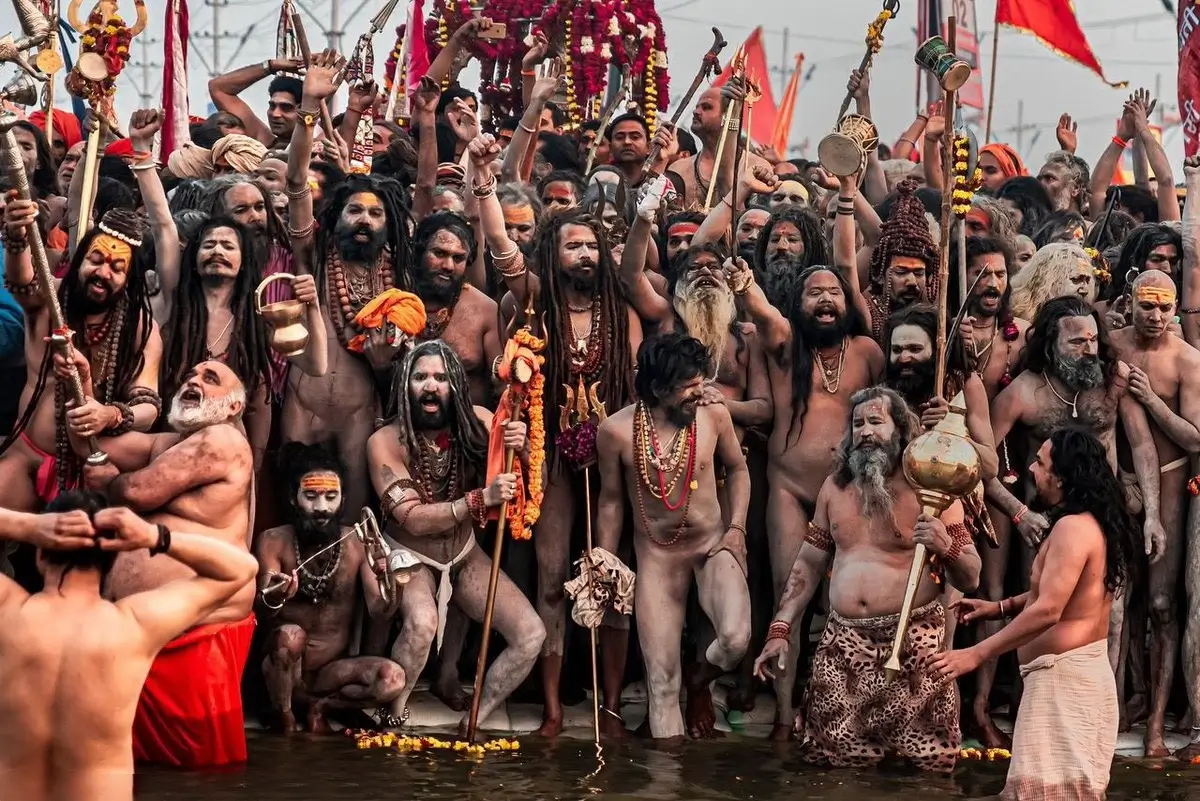
At the heart of the Simhastha are the Akharas, ancient monastic orders that preserve distinct spiritual lineages. These are not ceremonial groups assembled for the event; they are enduring institutions whose members often live in seclusion for most of their lives.
During the Kumbh, Akharas establish camps that function as centers of teaching, debate, initiation, and ritual authority. Their ceremonial processions, marked by Naga Sadhus, symbolic weaponry, and disciplined hierarchy, are not performances but expressions of inherited spiritual order. The Shahi processions reflect centuries-old agreements, rivalries, and resolutions that continue to shape the rhythm of the Kumbh.
Beyond Bathing: The Cultural Life of the Kumbh
While ritual bathing draws the largest attention, the Simhastha is equally sustained by its non-ritual life:
- Spiritual Discourses and Satsangs : Continuous philosophical dialogue forms the intellectual backbone of the Kumbh.
- Seva and Community Kitchens : Large-scale charitable service reflects the ethic of collective responsibility.
- Music, Chanting, and Oral Tradition : Knowledge is transmitted not through texts alone, but through sound and memory.
- Inter-sect Dialogue : The Kumbh acts as a rare meeting ground for diverse spiritual paths within Hinduism.
These elements transform the gathering into a temporary civilization rather than a single event.
Sacred Landscapes Around the Simhastha
The wider Nashik–Trimbakeshwar region forms an extended sacred map:
- Panchavati and Kalaram Temple anchor Ramayana traditions.
- Sita Gufa and Anjaneri Hills connect mythology with geography.
- Brahmagiri Hill, as the river’s source, represents spiritual origin.
- The Pandavleni Caves reveal the region’s layered religious history beyond Hinduism.
Together, these sites provide context rather than itinerary, deepening understanding of why this region has drawn seekers for millennia.
A Modern Gathering Rooted in Ancient Wisdom
Contemporary Simhastha Melas reflect a delicate balance between scale and sanctity. Environmental responsibility, technological integration, and crowd coordination now coexist with ritual purity and ascetic discipline. Yet despite modern systems, the Kumbh remains fundamentally human-powered, driven by faith, memory, and shared belief rather than spectacle.
Who is the Simhastha for?
The Simhastha Kumbh Mela is experienced differently by different people, shaped as much by individual intention as by ritual structure. For some, it is a lifelong spiritual commitment, a return to practices observed across generations. For others, it is a moment of cultural immersion, offering a rare window into living traditions that continue to shape Indian civilization.
At the same time, the Simhastha is physically demanding and emotionally intense. Its scale, pace, and sensory density can be overwhelming for those unprepared for prolonged walking, crowds, and highly structured ritual environments. Approaching the Kumbh with patience, humility, and openness often determines the depth of the experience more than familiarity with the ritual itself.
This range of responses is not a contradiction but a reflection of the Simhastha’s breadth, a gathering vast enough to accommodate devotion, curiosity, and quiet observation in equal measure.
Why the Simhastha Still Matters
In an increasingly fragmented world, the Simhastha Kumbh Mela stands as a reminder of collective spiritual identity. It dissolves social hierarchies, compresses time, and reconnects individuals with traditions far older than themselves. For some, it is a pilgrimage. For others, a cultural immersion. For many, it is simply an encounter with scale, devotion, and continuity that cannot be replicated elsewhere. The Simhastha Nashik Kumbh Mela 2027 is not just observed, it is entered, endured, and remembered.
How to Reach the Simhastha Region?
The Simhastha Kumbh Mela unfolds across Nashik and Trimbakeshwar, both of which are long-established pilgrimage centers in Maharashtra. During the Simhastha cycle, the region becomes part of a larger, temporarily restructured sacred zone rather than a conventional city landscape.
Nashik is connected to major Indian cities through rail, road, and limited air services, while Trimbakeshwar lies within the forested Brahmagiri range, traditionally approached by road from Nashik. Movement during the Simhastha period is shaped as much by ritual zoning and crowd regulation as by physical distance, reflecting the scale and sensitivity of the gathering.
Rather than functioning as a single-point destination, the Simhastha region operates as a distributed pilgrimage landscape, with access routes, ghats, and temple zones managed in alignment with ritual calendars and processional movement.
Movement & Participation: What to Keep in Mind
- Expect altered access patterns : During key ritual phases, movement within Nashik and Trimbakeshwar follows ceremonial and security-led routes rather than everyday city traffic flows.
- Walking is integral to the experience : Much of the Simhastha is navigated on foot, reflecting both practical necessity and pilgrimage tradition.
- Time operates differently : Distances that appear short on maps often take longer during the Simhastha, not due to inefficiency but due to ritual sequencing and crowd rhythm.
- Follow institutional guidance : Akhara processions, bathing cycles, and administrative instructions shape how spaces are used and accessed during the event.
These considerations are part of the Simhastha’s lived reality, reinforcing that participation is as much about adaptation and patience as it is about ritual observance.
Accommodation During the Simhastha: A Temporary Sacred City
During the Simhastha Kumbh Mela, the Nashik–Trimbakeshwar region functions not as a conventional host city but as a vast, temporary settlement system designed to absorb an extraordinary influx of pilgrims and ascetic communities.
Accommodation during the Simhastha extends beyond permanent hotels and lodgings. Large tented settlements and monastic camps established by Akharas, dharamshalas, and community-run shelters together form a layered housing network that mirrors the social and spiritual diversity of the gathering. These temporary habitats are organized around ritual zones, processional routes, and bathing ghats rather than commercial districts.
For many participants, accommodation is not merely a matter of rest but an extension of pilgrimage life: shared spaces, simple living conditions, and proximity to ritual activity are often embraced as part of the spiritual discipline associated with the Kumbh.
This system of temporary habitation is one of the Simhastha’s most remarkable organizational achievements, demonstrating how large-scale human movement has been sustained for centuries through collective effort, institutional coordination, and voluntary service.



 +91-9212777225
 Plan Your trip