West Bengal is an Indian state known for its rich culture and traditions. Varied hues of its cultural richness can be witnessed in its folk songs and musical forms. The Classical Bangla Music, sculpted around the quintessential seven ragas, or the seven musical notes, serves as the base for the majority of the varieties. Some of the most popular of these inherited music forms include the Padavali Kirtan, Shyama Sangeet and Jaydev’s Gita Govinda.
When it comes to West Bengal’s most legendary music forms, the list is incomplete without the mention of the renowned Rabindra Sangeet. A compilation of songs written and composed by the great poet and Nobel laureate, Rabindranath Tagore, Rabindra Sangeet has carved its own niche in the field of music of West Bengal. Soulful and intellectual in nature, the genre brilliantly weaves together the human emotions of philosophy, love and devotion, the outcome of which is no less than magical.
Yet another popular music of Bengal happens to be the Baul Sangeet. A genre of folk music, it is highly spiritual in nature, and resembles Sufi Music to a great extent. The songs of Baul are a deep expression of love for the almighty in the purest form, and urge human beings to find God within themselves instead of searching for him in temples, churches or mosques. As far as the musical instruments is concerned, ‘Ektara’, a one-string adorned instrument, is the prized possession of every Baul singer.
Devotional music is another genre in the music of West Bengal. The compositions related to this music form are dedicated to Goddess Kali, also known as ‘Shyama’ in Bengal. Originating around the 12th century, what makes Shyama Sangeet popular even till date is its realistic appeal to human kind, where the goddess is conceptualized as a loving mother, and we, the devotees, as her child, long for her blissful love. Another significant highlight of this genre is its beautiful compositions that depict stories from real life and social events.
Nazrul Geeti, another genre of Bangla music, was developed by the great revolutionary poet, Kabi Nazrul Ismal. Highly motivational and revolutionary in nature with strong and powerful words, these songs got an immense popularity during the Indian freedom struggle and the Bangladesh Liberation War. Among the most noted compositions, "Karar Oi Louho Kopat" is best known and has been used in several patriotic movies, both in India and Bangladesh.
Music of West Bengal has also been influenced by western style of music. This has given rise to Adhunik Sangeet. The compositions are mostly built on catchy tunes with plain and simple lyrics. Adhunik Bengali Sangeet is considered to be the music of masses and has to it many sub-genres, the most important of them being Bengali Pop and Bengali Rock music.
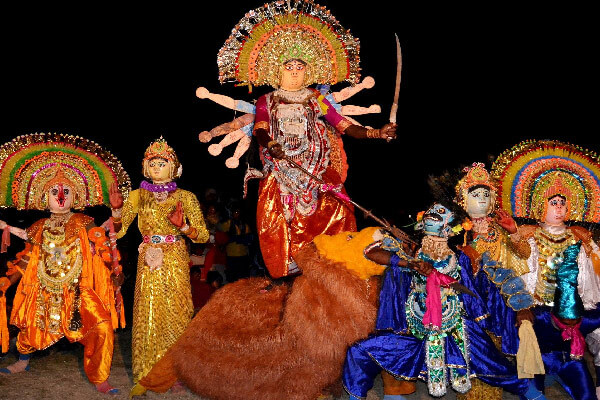
Dance is as essential a component as music in the culture of West Bengal. Starting with Gambhira that originated around the Malda District in West Bengal, it is a highly popular folk dance and is performed during the festival of Chaitra Sankranti. The dance revolves around two masked performers, depicting a man and his maternal grandfather. An important highlight of Gombhira is its folk-play, which aims at raising awareness regarding moral problems and ill practices prevalent in the society.
Amongst several folk dances popular in West Bengal, Brita or the Vrita Dance is considered the most special. A traditional folk dance, it has prominent touches of spirituality and is performed as an expression of gratitude and thankfulness to the almighty. Brita is also highly popular amongst the so-called barren women of Bengal who perform this dance to seek blessing of God in the form of a child. It is customary to dance once again when their wish is fulfilled.
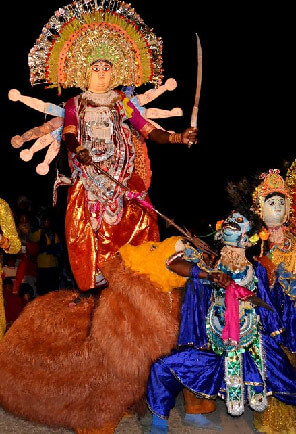
Another famous folk art of West Bengal is the popular Chhau Dance. A unique blend of martial, tribal and folk traditions, the dance revolves around a festive theme and depicts stories from mythological epics like Ramayana and Mahabharata. During the performance, the dancers wear elaborate masks, headgears and vibrant costumes, which essentially make for an interesting highlight. Chhau Dance is incomplete without the use of musical instruments. Needless to say, Dhol, Shehnai and Dhamsa play a critical role in making the recital come to life.
Tusu is also a significant and popular folk dance of West Bengal. Celebrated on the auspicious day of Makar Sankranti in January, it is performed by a group of young unmarried girls dancing to the tunes of local folk songs and devotional verses. It does not involve any kind of musical instruments and is enriched by local variations.















 Plan Trip
 Call Us
 Packages
 Home
Home